








Artificial intelligence has quickly evolved from an experimental capability into a strategic investment for enterprise organizations. Across North America, companies are no longer asking whether they should adopt AI, but how they can integrate it into existing technology ecosystems without compromising performance, security, or compliance. While generative AI interfaces often capture the spotlight, the real foundation of successful AI initiatives lies in the backend.
For engineering leaders overseeing large-scale digital platforms, AI integration is less about connecting an API to a language model and more about designing resilient backend architectures that can support intelligent applications for years to come. Whether the goal is to automate customer support, accelerate internal operations, modernize legacy systems, or enable AI-powered products, the backend determines whether these initiatives remain isolated experiments or become core business capabilities.
The Shift from AI Features to AI Infrastructure
Many early enterprise AI projects focused on standalone chatbots or internal productivity tools. Although these applications demonstrated the potential of large language models, they often struggled to scale because they operated independently of existing enterprise systems.
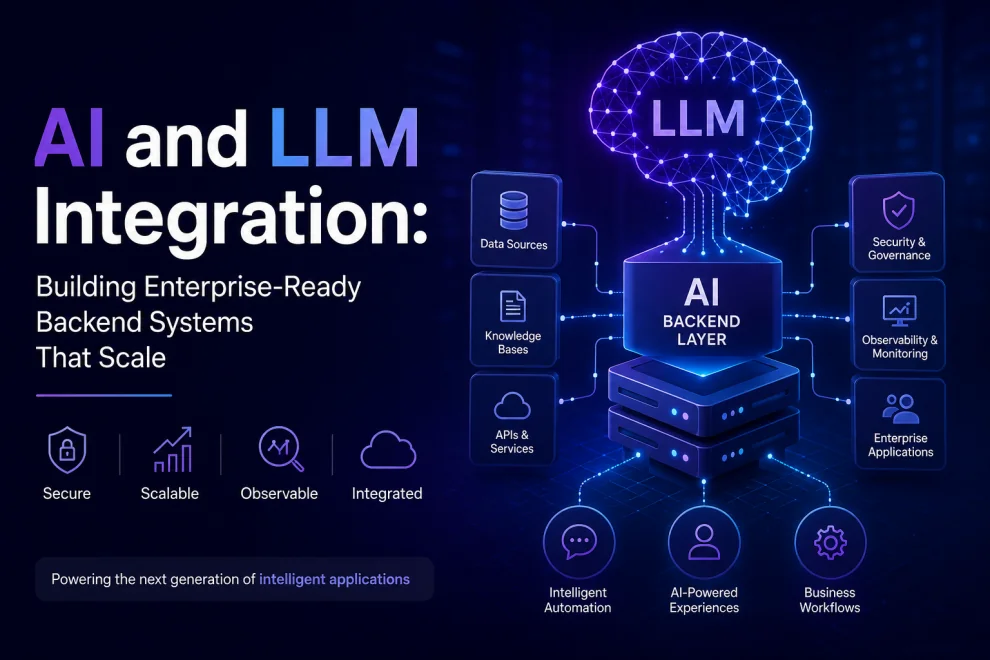
Today’s leading organizations are approaching AI differently. Rather than treating AI as another application feature, they are integrating it into backend services that already manage authentication, business workflows, APIs, data pipelines, analytics, and enterprise integrations. This approach allows AI to become part of the organization’s digital infrastructure instead of existing as a disconnected layer.
The result is a more reliable and scalable platform where AI can access business data securely, interact with existing applications, and deliver consistent experiences across multiple customer and employee touchpoints.
Why Backend Architecture Matters More Than the Model
Large language models continue to improve rapidly, but model quality alone does not determine the success of an enterprise AI initiative. Organizations often discover that challenges arise from backend architecture rather than the AI model itself.
Enterprise applications depend on secure APIs, governed access to business data, high availability, observability, and predictable performance. Without these foundational capabilities, AI systems become difficult to maintain, expensive to operate, and challenging to trust.
Modern backend architectures provide the orchestration layer that connects AI services with CRM platforms, ERP systems, customer databases, document repositories, and internal applications. Instead of allowing every application to communicate directly with a language model, organizations increasingly expose AI capabilities through managed backend services that enforce authentication, monitor usage, and maintain governance standards.
Connecting AI to Enterprise Knowledge
One of the biggest misconceptions surrounding large language models is that they already know everything an organization needs. In reality, enterprise value comes from enabling AI to understand company-specific information.
Modern backend platforms connect language models with internal knowledge bases, product documentation, customer records, operational procedures, technical documentation, and business policies. Rather than relying solely on information learned during model training, AI retrieves relevant enterprise data before generating a response.
This architecture significantly improves response accuracy while reducing hallucinations. More importantly, it enables organizations to keep sensitive business information under their own governance instead of exposing it unnecessarily to external systems.
Security Cannot Be an Afterthought
Enterprise AI introduces new security considerations that extend well beyond traditional application development. Every AI request has the potential to access sensitive customer information, intellectual property, financial records, or regulated healthcare data.
For engineering leaders, this means AI integrations must follow the same security principles applied across the rest of the technology stack. Identity management, role-based access controls, encryption, audit logging, and policy enforcement should exist before a request reaches a language model.
Organizations operating under regulations such as HIPAA, SOC 2, PCI DSS, GDPR, or ISO 27001 cannot afford to create isolated AI systems that bypass existing governance frameworks. Instead, AI should inherit the same compliance controls already protecting enterprise applications.
Building AI Platforms That Scale
As AI adoption expands across multiple departments, backend scalability becomes increasingly important. Customer service, software engineering, sales, marketing, operations, and analytics teams may all depend on the same AI infrastructure simultaneously.
Backend platforms therefore need intelligent routing, workload management, caching, asynchronous processing, and fault tolerance to ensure consistent performance under heavy demand. Many enterprises also adopt multi-model strategies, allowing workloads to be distributed across different AI providers depending on cost, latency, geographic requirements, or use case complexity.
This flexibility not only improves operational resilience but also reduces long-term vendor lock-in, giving engineering teams greater control over infrastructure decisions.
Observability Is the Missing Layer in Many AI Projects
Traditional monitoring focuses on server health, API latency, and infrastructure utilization. AI systems introduce an entirely new set of operational metrics that engineering teams must understand.
Organizations now monitor response quality, inference latency, token consumption, retrieval accuracy, operational costs, prompt performance, and user feedback alongside conventional infrastructure metrics. Without this visibility, identifying the root cause of declining AI performance becomes extremely difficult.
Observability also helps organizations optimize infrastructure spending. As AI usage grows, token consumption and inference costs can increase rapidly if backend systems are not designed efficiently. Monitoring these metrics enables engineering teams to improve prompts, introduce intelligent caching, and optimize model selection without negatively affecting user experience.
Modernizing Legacy Systems Without Replacing Them
Large enterprises rarely have the luxury of rebuilding decades of technology investments from scratch. Financial institutions, healthcare providers, manufacturers, and retailers continue to rely on legacy ERP systems, on-premises databases, and custom enterprise applications that remain critical to daily operations.
Successful AI integration focuses on extending these systems rather than replacing them. Backend services act as the bridge between legacy infrastructure and modern AI capabilities, exposing existing business logic through secure APIs while allowing language models to interact with enterprise workflows in a controlled manner.
This incremental modernization strategy enables organizations to capture business value much faster while reducing migration risk.
Choosing the Right Engineering Partner
Implementing enterprise AI requires expertise across backend engineering, cloud infrastructure, security, DevOps, platform architecture, data engineering, and machine learning. Few organizations possess deep expertise across all of these disciplines internally.
This is where experienced engineering partners can accelerate adoption. Companies like GeekyAnts have increasingly worked with enterprises to design scalable backend architectures that support AI integration without sacrificing governance or performance. By combining product engineering expertise with cloud-native development and modern backend technologies, engineering teams can move beyond prototypes and build production-ready AI systems that align with long-term business objectives.
Rather than focusing solely on integrating language models, the emphasis shifts toward building platforms that remain adaptable as AI technologies continue to evolve.
Looking Ahead
AI and LLM integration is rapidly becoming a core capability of enterprise backend engineering. As organizations continue investing in intelligent products and automated workflows, the differentiator will not be access to the latest language model but the ability to operationalize AI securely, reliably, and at scale.
For engineering executives responsible for enterprise platforms, the priority should be establishing backend architectures that treat AI as a foundational service rather than a standalone feature. Organizations that invest in secure integrations, scalable infrastructure, strong observability, and governance today will be better prepared to capitalize on future advances in AI while maintaining the reliability and trust expected from enterprise software.



Add Comment