








AI adoption is moving from experimentation to enterprise-wide implementation, but many organizations are discovering that their biggest challenge is not choosing the right AI model. It is preparing the backend infrastructure required to support AI at scale.
For years, enterprise applications were built around predictable workloads, centralized databases, and API-driven architectures designed for traditional software experiences. However, AI-powered applications introduce a completely different set of demands. They require real-time data access, intelligent automation, continuous model interactions, complex integrations, and the ability to process massive volumes of information efficiently.
For CTOs, VP of Engineering, and technology leaders managing large-scale digital platforms, backend architecture has become a strategic factor in determining whether AI initiatives succeed or struggle.
AI Scaling Problems Often Begin in the Backend
Many enterprises successfully build AI prototypes but face challenges when moving those systems into production. A chatbot that works for a small internal team may struggle when deployed across thousands of employees. An AI recommendation system may perform well during testing but slow down when processing real customer behavior. An AI agent may deliver impressive results but fail to integrate reliably with existing enterprise systems.
The difference between an AI experiment and an enterprise-ready AI platform is often the backend architecture supporting it.
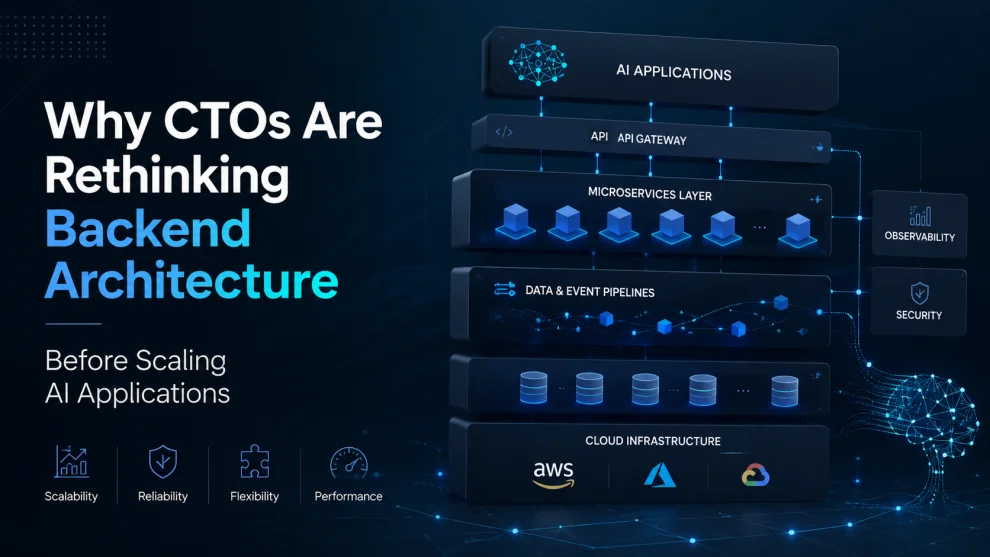
Modern AI applications depend on strong data pipelines, scalable APIs, secure integrations, vector databases, real-time processing capabilities, and reliable infrastructure. Without these foundations, even advanced AI models cannot deliver consistent business value.
Traditional Cloud Backends Were Not Designed for AI Workloads
Most enterprise backend systems were designed around applications where users send requests and receive responses. AI applications operate differently because they continuously interact with data, models, and external systems.
AI-powered platforms often require dynamic scaling because workloads can change based on user activity, data volume, and model complexity. They also require faster access to business information, which means backend systems must connect seamlessly with multiple data sources while maintaining security and governance.
This is pushing organizations to rethink backend architecture beyond conventional application development.
The Rise of AI-Ready Backend Platforms
Enterprise leaders are increasingly moving toward backend platforms designed specifically for AI-driven applications. These architectures focus on flexibility, scalability, and operational reliability.
Cloud-native development, microservices, event-driven systems, and automated infrastructure are becoming essential components of modern enterprise platforms. Instead of building AI features on top of outdated systems, organizations are redesigning their backend foundations to support continuous innovation.
The goal is not simply to add AI capabilities but to create an environment where AI applications can evolve, scale, and integrate across the business.
Platform Engineering Becomes Central to AI Adoption
As AI expands across departments, platform engineering plays a critical role in maintaining consistency and scalability. Large organizations cannot rely on individual teams creating disconnected AI solutions. They need internal platforms that provide secure environments, reusable components, deployment automation, monitoring, and governance.
A strong platform engineering approach enables development teams to build AI-powered products faster while maintaining enterprise standards around security, compliance, and reliability.
For companies operating at global scale, this approach reduces complexity and creates a foundation for long-term AI adoption.
Backend Modernization Is Becoming a Business Strategy
Backend modernization is no longer just a technical initiative. It has become a requirement for organizations looking to compete in an AI-driven market.
Modern backend architectures allow enterprises to connect fragmented systems, improve operational efficiency, support real-time decision-making, and accelerate digital product development.
Companies that delay backend modernization may find themselves limited by infrastructure that cannot support the speed and scale required for enterprise AI.
Organizations working toward AI transformation often partner with engineering teams that understand both modern backend development and emerging AI technologies. GeekyAnts helps enterprises build scalable digital platforms by combining backend engineering, cloud-native architecture, and AI capabilities to create production-ready systems.
The Future of Enterprise Software Depends on Backend Readiness
AI will continue evolving, but the organizations that gain the most value will not necessarily be those with access to the newest models. They will be the ones with backend architectures capable of turning AI capabilities into reliable business solutions.
For CTOs and engineering leaders, the next phase of digital transformation depends on building systems that are flexible enough for today’s AI demands and adaptable enough for tomorrow’s innovations.
The question is no longer whether enterprises should adopt AI. The question is whether their backend architecture is ready to support it.



Add Comment