








A user clicks “Place Order.” The API responds successfully. The application displays a confirmation, and from the customer’s perspective, everything appears to be working.
Behind the scenes, however, several operations are still running. An invoice needs to be generated, inventory must be updated, a confirmation email has to be sent, and payment information needs to be synchronized with another service.
These tasks are often handled by background workers.
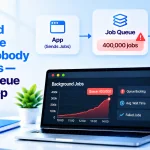
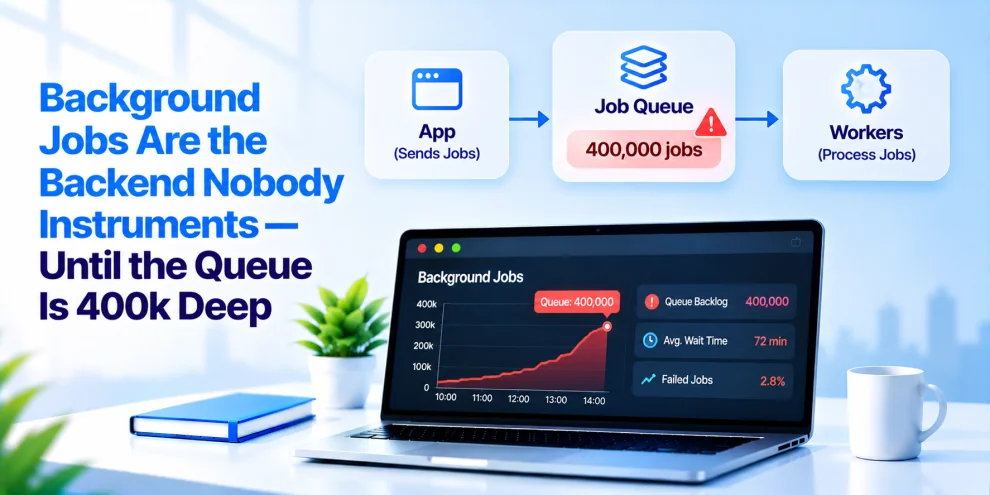
For a while, everything runs smoothly. Then a traffic spike, a slow downstream API, or a failed worker causes the queue to grow. Thousands of jobs become hundreds of thousands. Processing delays increase, retries multiply, and customers begin reporting that orders are stuck.
The problem is not necessarily the queue itself. It is that the backend system has been operating without sufficient visibility into what happens after an API request returns.
Background jobs are production infrastructure. Yet many engineering teams instrument their APIs, databases, and application servers far more carefully than their asynchronous workloads.
That gap becomes expensive when the queue reaches 400,000 pending jobs.
Why Background Jobs Become a Blind Spot
Background processing helps applications handle operations without making users wait for every task to finish.
Instead of executing everything during an HTTP request, the application places work on a queue. Workers consume jobs and process them independently.
Common examples include:
- Sending emails, notifications, and OTPs
- Generating reports and documents
- Processing payments and refunds
- Updating search indexes
- Synchronizing external systems
- Processing images, videos, and uploaded files
- Running AI inference and data pipelines
The architecture improves responsiveness, but it introduces a separate execution layer with its own failure modes.
A successful API response does not guarantee that the background operation will eventually succeed.
A job can remain pending, execute slowly, fail repeatedly, get duplicated, or become permanently stuck. Without appropriate instrumentation, these problems may remain invisible until they affect customers.
The Queue Depth Problem Is Only the Beginning
Queue depth is one of the most visible indicators of background processing health. It measures how many jobs are waiting to be processed.
But queue depth alone does not explain whether the system is healthy.
Consider two situations:
- Queue A contains 20,000 jobs, but workers process 25,000 jobs per minute.
- Queue B contains 5,000 jobs, but workers process only 100 jobs per minute.
Queue B may represent a more serious operational problem despite having fewer pending jobs.
Engineering teams need to understand queue growth alongside processing capacity, job age, execution duration, failure rates, and retry behaviour.
1. Queue Depth
A continuously growing queue indicates that jobs are arriving faster than workers can process them.
This may result from increased traffic, insufficient worker capacity, inefficient job execution, or a downstream dependency slowing processing.
2. Queue Age
The age of the oldest pending job often provides a better indication of customer impact than queue depth.
For example, a queue with 10,000 jobs may be acceptable if they are processed within seconds. A queue with 500 jobs may be problematic if some have been waiting for several hours.
3. Processing Throughput
Teams should measure how many jobs workers successfully complete within a defined period.
If incoming jobs consistently exceed completed jobs, backlog growth is inevitable.
4. Job Execution Time
Long-running jobs consume worker capacity and reduce throughput.
Tracking average execution time alongside p95 and p99 latency helps identify slow operations that may not be visible in overall averages.
5. Failure and Retry Rates
Repeated failures can create additional queue pressure.
A job that fails and retries several times consumes more processing capacity than a job that succeeds on its first attempt.
Six Metrics Every Background Job System Should Track
A reliable asynchronous architecture needs instrumentation at the queue, worker, and individual job levels.
| Metric | What It Reveals |
|---|---|
| Queue depth | Number of pending jobs |
| Oldest job age | How long work has been waiting |
| Processing throughput | Jobs completed per minute |
| Job execution latency | Time required to process jobs |
| Failure rate | Percentage of unsuccessful jobs |
| Retry and dead-letter count | Repeated failures and jobs requiring investigation |
These metrics should be available per queue and, where possible, per job type.
A single dashboard showing total queue depth can hide the fact that payment processing is healthy while invoice generation is falling behind.
Why Background Jobs Fail at Scale
Understanding the metrics is only part of the problem. Teams also need to identify the architectural issues that cause queues to accumulate.
1. Worker Capacity Does Not Match Demand
A fixed number of workers may handle normal traffic but fail during peak periods.
If job arrival rates increase while worker capacity remains constant, pending work accumulates.
Autoscaling can help, but scaling decisions should consider queue age, throughput, and resource consumption rather than queue depth alone.
2. Slow Dependencies Block Workers
A worker may depend on a payment provider, email service, external API, or database.
If a downstream service becomes slow, workers spend more time waiting and process fewer jobs.
Timeouts, circuit breakers, bounded concurrency, and dependency-level monitoring help prevent one failing service from affecting the entire processing system.
3. Retry Storms Multiply Workloads
Retries are important because temporary failures are common in distributed systems.
However, immediate or aggressive retries can make an outage worse. Thousands of jobs may repeatedly hit an already struggling dependency.
Use exponential backoff, jitter, maximum retry attempts, and dead-letter queues to control repeated execution.
4. Jobs Are Not Idempotent
A job may execute successfully but fail before acknowledging completion. The queue system may then deliver it again.
If the operation is not idempotent, duplicate execution can create multiple payments, duplicate notifications, or inconsistent records.
Use idempotency keys, unique job identifiers, database constraints, and transactional processing where appropriate.
5. One Queue Handles Unrelated Workloads
Combining critical and non-critical jobs can create resource contention.
For example, a large report-generation workload might delay payment notifications or order-processing tasks.
Separate queues by priority, workload characteristics, or business criticality. Set independent concurrency limits and service expectations.
Building an Observable Background Job Architecture
Instrumentation should be designed into the job-processing lifecycle rather than added after a production incident.
A practical architecture includes the following layers.
1. Job Enqueue Instrumentation
When an application publishes a job, record its job type, queue name, timestamp, correlation ID, and relevant business identifier.
This makes it possible to trace a task from the original API request to its eventual execution.
Avoid logging sensitive payloads or credentials.
2. Worker-Level Metrics
Workers should expose operational metrics such as active jobs, idle workers, processing throughput, execution duration, and failures.
These measurements help distinguish between insufficient capacity and slow job execution.
3. Distributed Tracing
A background job should retain trace context from the operation that created it whenever the tracing architecture supports it.
This allows engineers to connect the original request with queue publishing, job execution, database queries, and downstream API calls.
For asynchronous systems, trace links may be more appropriate than keeping a single request span open until the job finishes.
4. Structured Logging
Every job execution should produce searchable logs with consistent identifiers.
Useful fields include:
- Job ID and job type
- Queue name
- Worker identifier
- Attempt number
- Execution duration
- Completion status
- Error category
- Correlation or trace ID
This makes it easier to investigate recurring failures and identify patterns across workers.
5. Dead-Letter Queue Monitoring
Jobs that exceed their retry limits should move to a dead-letter queue or an equivalent failure-management mechanism.
But moving a job out of the main queue does not resolve the underlying problem.
Teams need alerts for dead-letter growth, investigation workflows, controlled replay mechanisms, and safeguards against repeatedly introducing invalid jobs.
Alert on Business Impact, Not Just Queue Size
A queue-depth alert is useful, but it should not be the only operational signal.
Alerts should reflect what customers and business operations actually experience.
For example:
- Payment jobs waiting longer than their processing objective
- Order confirmation tasks exceeding acceptable delays
- Oldest pending job age increasing continuously
- Failure rates crossing defined thresholds
- Dead-letter queues receiving unexpected volumes
- Worker throughput falling below incoming job volume
Different job types need different service-level objectives. A report that takes several minutes may be acceptable, while a payment confirmation delayed by the same amount may require immediate attention.
This approach helps engineering teams prioritize incidents according to business impact.
Where Engineering Teams Fit
Building reliable asynchronous systems requires more than selecting a message broker or increasing worker counts. It involves backend architecture, database design, distributed processing, observability, and failure recovery.
Teams such as GeekyAnts and Thoughtworks work across backend engineering and product development, making them worth considering for organizations modernizing application infrastructure or building scalable systems that depend on reliable background processing.
Conclusion
Background jobs often operate outside the immediate user experience, but they remain essential to application reliability.
A successful API response does not mean the work is complete. If asynchronous processing is poorly monitored, a growing backlog can delay business operations long before the application appears unhealthy.
Engineering teams should treat queues and workers as first-class production infrastructure. Monitoring queue depth, job age, throughput, execution latency, retries, and failures provides the visibility needed to detect problems early.
The goal is not simply to prevent a queue from reaching 400,000 jobs. It is to understand why work is accumulating, identify its business impact, and restore processing capacity before customers notice.
FAQs
1. What is queue depth in background job processing?
Queue depth is the number of jobs waiting to be processed. A continuously increasing depth may indicate that incoming jobs exceed worker processing capacity.
2. Why is queue age important?
Queue age measures how long jobs have been waiting. It helps identify delayed processing and customer impact, even when the total number of pending jobs is relatively small.
3. What metrics should be monitored for background jobs?
Important metrics include queue depth, oldest job age, processing throughput, execution latency, failure rate, retry count, worker utilization, and dead-letter queue volume.
4. How can teams prevent background job retry storms?
Use exponential backoff, randomized jitter, maximum retry limits, timeouts, circuit breakers, and dead-letter queues to prevent repeated failures from overwhelming workers.
5. What is the difference between a message queue and a background worker?
A message queue stores and distributes tasks waiting for execution. A background worker consumes those tasks and performs the actual processing.
6. How can background job systems scale?
Teams can scale workers horizontally, introduce queue partitioning, prioritize critical workloads, optimize job execution, and use autoscaling based on queue age, throughput, and resource utilization.
For more, visit our homepage!



Add Comment