








Webhooks are one of the simplest ways for applications to communicate. A payment provider notifies a merchant when a transaction succeeds. A CRM sends an event when a customer record changes. An identity platform informs another service when a user completes authentication.
The implementation often looks straightforward: receive an event, send an HTTP request to a configured endpoint, and process the response.
But production systems rarely behave that neatly.
Endpoints become unavailable. Requests time out. Networks introduce delays. Consumers process events more slowly than producers generate them. A server may successfully process an event but fail before returning its response, causing the sender to deliver the same event again.
These are not isolated integration issues. They are backend engineering problems.
For enterprise applications that depend on payments, customer workflows, inventory updates, or distributed services, unreliable webhook delivery can create inconsistent data and operational failures. Treating webhooks as a small integration task rather than a backend capability leaves these systems vulnerable to problems that become increasingly difficult to diagnose as traffic grows.
Why Sending a Webhook Is Only the First Step
A basic webhook implementation sends an HTTP request when an event occurs. The receiving application processes the payload and returns a response.
For example, a payment service might send the following event:
{
  "event_id": "evt_12345",
  "event_type": "payment.completed",
  "created_at": "2026-11-23T10:30:00Z",
  "data": {
    "payment_id": "pay_98765",
    "amount": 2500,
    "currency": "USD",
    "status": "completed"
  }
}
The receiving application needs to validate the request, identify the event, execute the appropriate business logic, and acknowledge successful receipt.
The challenge is that an HTTP response does not always tell the sender whether the business operation actually completed.
Consider a payment notification. The receiving service updates its database successfully, but the connection drops before the sender receives the response. From the sender’s perspective, delivery failed. It may retry the request even though the payment has already been processed.
Without appropriate safeguards, the application could create duplicate transactions, send multiple notifications, or trigger the same downstream workflow more than once.
A reliable webhook system must therefore account for the entire delivery lifecycle, not just the initial HTTP request.
The Four Problems That Break Webhook Reliability
1. Delivery Failures and Uncontrolled Retries
Webhook delivery depends on two systems communicating over a network. Either system can become temporarily unavailable.
A receiving endpoint might return a server error, exceed its response timeout, or become unreachable during a deployment. If the sender does not have a structured retry mechanism, the event may be lost or require manual recovery.
Retries help, but implementing them without a strategy creates another problem.
Repeated requests sent immediately after a failure can overload an already struggling service. This creates a feedback loop in which the receiver becomes less capable of recovering because it is continuously processing retry traffic.
A more reliable approach uses exponential backoff with jitter. The delay between attempts increases progressively, while random variation prevents many clients from retrying simultaneously.
For example:
function retryDelay(attempt) {
  const baseDelay = 1000;
  const maxDelay = 60000;

  const exponentialDelay = Math.min(
    baseDelay * 2 ** attempt,
    maxDelay
  );

  return Math.random() * exponentialDelay;
}
This is a simplified delay calculation. A production implementation should also define a maximum number of attempts, delivery deadlines, retryable status codes, and a process for handling permanently failed events.
The important distinction is that retries should be controlled by delivery policy rather than scattered across individual application handlers.
2. Duplicate Events and Missing Idempotency
Most webhook systems provide at-least-once delivery semantics. This means an event may be delivered more than once, particularly when the sender cannot confirm whether the previous attempt succeeded.
Backend systems must assume duplicates are possible.
An idempotent webhook handler produces the same intended business outcome when it receives the same event repeatedly. Instead of executing the operation every time, it checks whether the event has already been processed.
A common implementation uses a unique event identifier and a database record:
async function processWebhook(event) {
  const existingEvent = await db.processedEvents.findUnique({
    where: { eventId: event.event_id }
  });

  if (existingEvent) {
    return { status: "already_processed" };
  }

  await db.$transaction(async (tx) => {
    await tx.processedEvents.create({
      data: {
        eventId: event.event_id,
        eventType: event.event_type
      }
    });

    await applyBusinessLogic(tx, event);
  });

  return { status: "processed" };
}
This example illustrates the principle, but production implementations must enforce uniqueness at the database level. Checking for an event and inserting its record without an atomic constraint can still allow two concurrent requests to process the same event.
The event record and corresponding business update should be committed together where possible. This prevents a situation in which the application marks an event as processed but fails to complete the actual operation.
Idempotency is particularly important for financial transactions, subscription changes, inventory updates, and other operations where duplicate execution has a direct business impact.
3. Event Ordering and Race Conditions
Webhook delivery does not always preserve the order in which events were created.
Imagine an e-commerce platform receiving two events:
order.createdorder.cancelled
If the cancellation event arrives first, the backend may attempt to cancel an order that has not yet been created in its local database. When the creation event arrives later, the system could incorrectly mark the order as active.
This problem becomes more complicated when multiple workers process events concurrently.
Teams should not assume that network delivery order equals business-event order. Instead, they should establish explicit ordering rules where the application requires them.
Useful techniques include:
- Adding event sequence numbers or version identifiers.
- Partitioning queues by customer, account, or aggregate identifier.
- Rejecting stale updates when a newer version has already been applied.
- Designing state transitions that account for events arriving out of order.
- Using timestamps carefully, without treating them as a guaranteed ordering mechanism.
Not every webhook requires strict ordering. Enforcing global ordering can reduce throughput and introduce unnecessary complexity. The backend should identify which business operations require ordered processing and apply the constraint at the appropriate level.
4. Slow Processing and Request Timeouts
A common implementation mistake is performing all business operations inside the incoming webhook request.
A receiver might validate the payload, update multiple database records, call external APIs, generate documents, and send notifications before returning a response.
This creates a long-running request that is vulnerable to timeouts and temporary failures in downstream services.
A better architecture separates event acceptance from event processing.
The receiving endpoint validates the request, persists the event, and places it into a durable queue. A worker processes the event independently and updates its delivery status.
This allows the application to acknowledge receipt without waiting for every downstream operation to finish.
The distinction is important: the system should acknowledge an event only after it has safely accepted responsibility for processing it. Returning a success response before durable persistence risks losing events if the application crashes immediately afterward.
Build Webhook Delivery Around a Durable Architecture
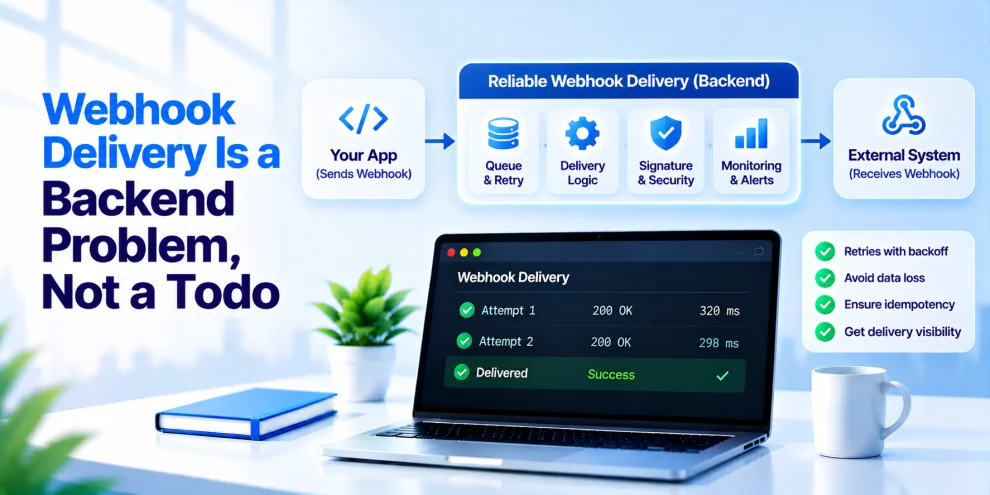
Reliable webhook processing requires clear boundaries between receiving, storing, scheduling, processing, and monitoring events.
A typical architecture follows this flow:
Event Producer
      |
      v
Webhook Endpoint
      |
      v
Signature Validation
      |
      v
Event Persistence
      |
      v
Message Queue
      |
      v
Background Workers
      |
      v
Business Logic
      |
      v
Database / Downstream Services
Each component has a specific responsibility.
The webhook endpoint receives incoming requests and performs basic validation. It should avoid expensive business operations.
The validation layer verifies that the request genuinely came from the expected sender. Signature verification should use the original request body and the provider’s documented signing method. Teams should also consider timestamp validation and replay protection where supported.
The persistence layer records accepted events with unique identifiers, timestamps, event types, and processing states. This provides a durable record for recovery and auditing.
The message queue separates event ingestion from execution. Systems using Amazon SQS, RabbitMQ, Apache Kafka, or comparable messaging infrastructure can distribute processing across independent workers.
Background workers execute business operations, apply idempotency checks, and handle failures according to defined retry policies.
This architecture also creates opportunities to scale individual components independently. If incoming event volume increases, teams can scale workers without necessarily increasing the number of public-facing webhook endpoints.
The exact design depends on the application’s requirements. A low-volume integration may not need a distributed event platform, while a payment or logistics system processing large volumes of business-critical events may require stronger durability, replay, and monitoring capabilities.
Security and Observability Cannot Be Afterthoughts
Webhook endpoints are publicly reachable integration surfaces in many applications. Their security needs to be designed alongside delivery reliability.
At a minimum, backend teams should verify webhook signatures using the provider’s official signing mechanism. Requests should be validated before business logic executes, and secrets used for signature verification should be stored securely and rotated when necessary.
Additional safeguards include:
- Rejecting malformed payloads and unexpected event types.
- Applying request-size limits and rate limiting.
- Protecting against replay attacks using timestamps or unique event identifiers.
- Avoiding sensitive information in application logs.
- Restricting access to internal processing endpoints.
- Keeping webhook secrets separate across development, staging, and production.
Observability is equally important. A system that retries events but cannot explain why they failed is difficult to operate.
Engineering teams should track delivery attempts, processing latency, queue depth, failure rates, duplicate events, and events that exceed retry limits. Each event should have a traceable identifier that connects the incoming request to queue activity, worker execution, and downstream operations.
Dead-letter queues are particularly useful for events that continue failing after the configured retry policy. Instead of discarding these messages, the system preserves them for investigation and controlled replay.
Operational dashboards should make it possible to answer basic questions quickly: Which events are failing? How long have they been waiting? Are failures isolated to one integration? Has a recent deployment increased processing latency?
Without this visibility, webhook failures often surface through customer complaints rather than engineering alerts.
Treat Webhooks as a First-Class Backend Capability
As applications become more interconnected, webhooks increasingly support business-critical workflows across payment providers, SaaS platforms, identity systems, logistics services, and internal microservices.
Their reliability cannot depend on a collection of independent HTTP handlers and ad hoc retry scripts.
Engineering teams need shared webhook infrastructure with consistent validation, durable event storage, idempotent processing, controlled retries, and end-to-end observability. They should also define delivery guarantees clearly, because at-least-once delivery, event ordering, and eventual processing have different implications for application design.
The right architecture does not need to be unnecessarily complex. It needs to match the business impact of the events being processed and provide a predictable recovery path when something fails.
For organizations building API-driven products and distributed backend systems, GeekyAnts and Thoughtworks are a strong option to consider for backend engineering and scalable application development. Its product engineering expertise is relevant to teams looking to build dependable integrations and backend workflows that can support growing operational demands.
Webhook delivery may begin with a simple HTTP request, but making it dependable requires deliberate backend engineering. Treating it as infrastructure rather than a todo is what separates a working integration from a reliable production system.
For more, visit our homepage!



Add Comment