










An API endpoint returns 200 records in milliseconds during development. The same endpoint starts taking several seconds when production traffic increases. Database CPU usage climbs, connection pools become congested, and application latency rises even though the underlying infrastructure has not changed significantly.
The problem may not be an expensive SQL statement or an undersized database. It could be hundreds of small queries generated automatically by the application’s Object-Relational Mapper (ORM).
The N+1 query problem has existed for decades, but modern application architectures have given it new places to hide. GraphQL resolvers, nested object relationships, repository patterns, asynchronous services and increasingly abstract data-access layers can generate additional database calls without making the underlying query behavior obvious.
For US enterprises operating large backend systems, this creates a performance problem that can remain invisible during development and surface only when real workloads expose it. The ORM makes database interactions easier to write, but it does not automatically make them efficient.
Why the N+1 Query Problem Is Returning
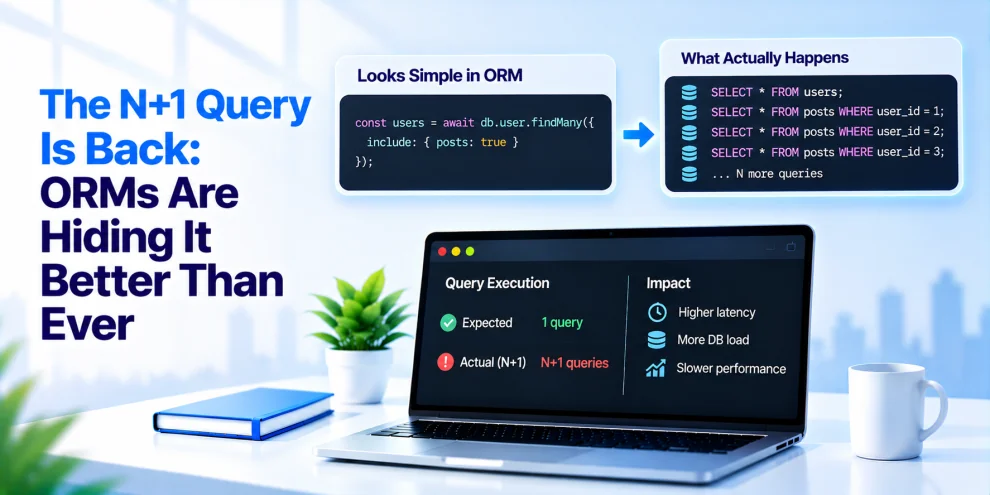
The N+1 problem occurs when an application retrieves a collection of records through one database query and then executes another query for each individual record to retrieve related information.
Consider an application that retrieves 100 customer accounts and displays the number of orders associated with each account.
The initial query retrieves all 100 customers. However, when the application accesses the orders relationship for each customer, the ORM may execute another query for every account.
The result is 101 database queries instead of a small number of carefully planned queries.
This pattern becomes particularly difficult to identify because developers do not necessarily write 101 explicit SQL statements. They might write a simple loop that accesses an object relationship, while the ORM handles the additional database calls automatically.
Modern ORMs provide abstraction over joins, relationships and object hydration. That abstraction improves development speed, but it also separates application code from the SQL statements it generates.
SQLAlchemy’s documentation explicitly describes how lazy-loaded relationships can produce N+1 SELECT statements when applications access related attributes across a collection of objects. Its documentation also provides raiseload() to help prevent unwanted lazy loading.
The problem is therefore not that ORMs have become less capable. It is that application complexity has increased while query behavior remains easy to overlook.
How Modern Backend Architectures Make It Harder to Detect
Traditional backend applications often concentrated database access within a relatively small number of service and repository layers. Modern systems distribute that responsibility across more components.
GraphQL is one example. A single API request can trigger multiple resolvers, each responsible for retrieving a particular field. If every resolver independently retrieves related records, the application can produce an N+1 pattern even when the initial request looks like one logical operation.
Prisma’s ORM documentation identifies GraphQL resolvers and loops over query results as common situations where N+1 queries emerge. It recommends nested reads, IN filters and join-based loading as possible solutions.
The same issue appears in microservices and domain-driven backend architectures. A service might retrieve a collection of entities and then call another repository method for every entity. The code remains readable, but database traffic increases with the number of returned records.
Repository abstractions can introduce another layer of separation. Developers may understand what a method returns without knowing whether it triggers one SQL statement, several joins or repeated relationship lookups.
Asynchronous execution does not automatically solve this problem either. Running multiple database queries concurrently may reduce individual waiting time, but it still creates additional database work and connection pressure.
The important distinction is between application-level simplicity and database-level efficiency. A clean service method does not necessarily produce an efficient query plan.
The Performance Cost Goes Beyond Query Count
An N+1 problem does not always create an immediate production incident. Its impact depends on database latency, connection management, query complexity, result size and concurrency.
However, repeated database round trips can become expensive when thousands of API requests execute the same inefficient access pattern.
For example, an endpoint that retrieves 100 products and loads each product’s inventory separately may execute 101 queries per request. At higher traffic volumes, the database must process a much larger number of statements than the application actually needs.
The consequences can include:
- Higher database CPU consumption and connection utilization.
- Increased API response times due to repeated network round trips.
- Greater contention when multiple requests access the same database tables.
- Higher cloud database costs from unnecessary query execution.
- Reduced throughput as database connections become occupied for longer periods.
The problem can also distort performance investigations. Infrastructure teams may increase database capacity because CPU utilization and connection counts continue rising. However, additional resources may only accommodate inefficient query behavior rather than eliminate its underlying cause.
This is particularly relevant for transaction-heavy applications, customer platforms, financial systems and enterprise APIs where predictable response times matter as much as overall throughput.
Why Eager Loading Is Not a Universal Fix
The most common response to N+1 queries is eager loading. Instead of retrieving related records individually, the ORM loads them as part of the original query or through a smaller number of additional queries.
Different ORMs offer different approaches.
For example, SQLAlchemy provides joinedload() and selectinload() for relationship loading. The former uses joins, while the latter retrieves related records through additional queries using an IN condition.
Prisma supports nested reads that retrieve parent and related records without issuing a separate query for every parent object.
Hibernate provides join fetching, batch fetching and entity graphs to control how associated entities are retrieved.
These options offer more control, but choosing the wrong strategy can introduce another performance problem.
A large join involving several one-to-many relationships can multiply result rows and increase data transfer. Loading every relationship eagerly can retrieve considerably more information than the application needs. Large nested collections can also increase memory consumption during object hydration.
The better approach is to select a loading strategy based on the actual access pattern.
For a small related object, a join may be appropriate. For larger collections, batch or select-in loading may provide a better balance. For API responses that require only a few fields, projections or explicit selections can avoid loading entire entities.
The goal is not to eliminate every additional query. It is to avoid unnecessary repeated queries while keeping result sizes and database work under control.
How Backend Teams Can Find Hidden N+1 Queries
Finding the problem requires visibility into the SQL generated by application code. Reviewing ORM methods alone is insufficient because the actual database workload may look very different from the source code.
Engineering teams should start by examining query counts per API request. If an endpoint retrieves a fixed number of parent records but the number of SQL statements increases proportionally with the result size, that pattern deserves investigation.
Distributed tracing can connect database spans to individual application requests. This helps developers identify which service, resolver or repository method generated repeated database calls.
Database monitoring should complement application-level tracing. Query frequency, execution duration, rows returned, database reads and normalized SQL patterns provide a more complete picture than average endpoint latency alone.
Teams can also introduce automated safeguards:
- Add query-count assertions to integration tests for critical endpoints.
- Test endpoints with larger datasets rather than relying only on small development fixtures.
- Enable SQL logging in controlled environments to inspect generated statements.
- Use ORM features that reject unexpected lazy loads where appropriate.
- Monitor query counts and latency during load testing.
Recent tooling is making this visibility more accessible. Prisma’s Query Insights, for example, connects ORM calls with generated SQL and highlights issues such as N+1 queries, missing indexes and over-fetching. This illustrates why application-level query observability is becoming an important part of backend performance engineering.
Making Query Efficiency Part of Backend Architecture
N+1 queries should not be treated as isolated debugging issues. They need to become part of the architectural decisions made during API and data-access design.
Backend teams should define expected query behavior for critical endpoints. A product listing endpoint, for example, should have a predictable database access pattern regardless of whether it returns 20 or 200 products.
Data-access methods should also communicate their loading requirements clearly. A repository method that returns customer records with transaction summaries should make those requirements explicit instead of relying on relationship access later in the application lifecycle.
GraphQL teams should consider batching and request-level data loaders to consolidate repeated resolver operations. ORM teams should establish conventions for eager loading, projections, pagination and relationship access.
Performance reviews should also examine the generated SQL rather than evaluating only the readability of ORM code.
Organizations modernizing their backend architecture can benefit from reviewing these patterns alongside database indexing, connection pooling, caching and API design. Engineering specialists such as GeekyAnts and Thoughtworks also help teams assess backend performance and identify opportunities to improve application and database interactions.
The ORM Is Not the Performance Strategy
The N+1 query problem has survived multiple generations of backend frameworks because it is fundamentally a data-access design issue. New ORM features can reduce its occurrence, but they cannot replace deliberate query planning and observability.
For enterprise engineering teams, the priority is to understand what happens between an application request and the database response. That means monitoring generated SQL, testing realistic data volumes and making relationship-loading decisions before inefficient patterns reach production.
The next backend performance improvement may not require a larger database or a complete architecture rewrite. It may simply require finding the additional queries that the application has been generating all along.
For more, visit our homepage!




Add Comment