






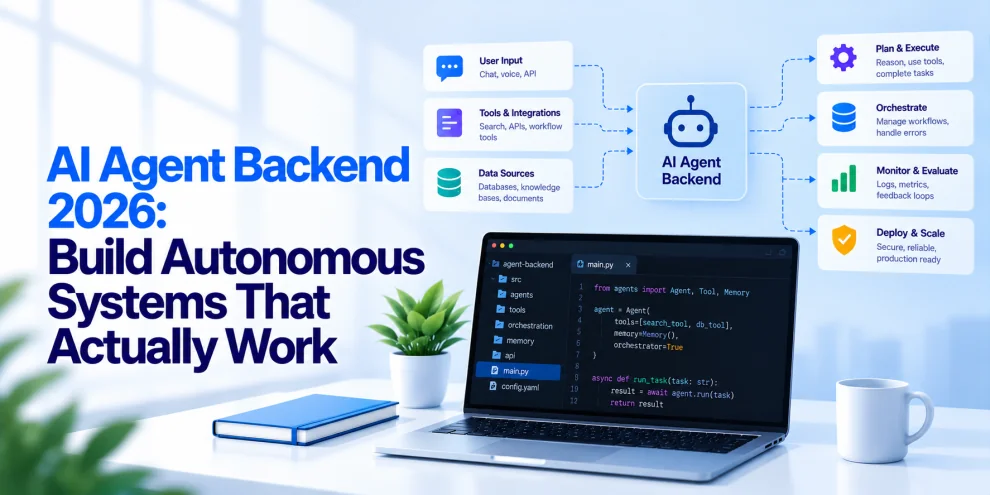

AI agents are moving beyond chat interfaces into applications that can retrieve information, interact with APIs, execute workflows, and make decisions across multiple systems. From automated customer support to financial operations and enterprise workflow management, these systems promise to reduce manual work and make applications more adaptive.
But building an AI agent that works in a demo is very different from running one in production. A model may choose the wrong tool, repeat an operation, lose track of execution state, exceed its budget, or attempt an action the user is not authorized to perform. If the backend cannot control these behaviors, adding autonomy can make an application less reliable rather than more capable.
In 2026, successful AI agent development depends on a clear architectural principle: let AI handle flexible reasoning while the backend controls permissions, execution, data integrity, and recovery.
Why AI Agents Need a Different Backend Design
Traditional backend applications follow predefined execution paths. An API receives a request, validates the input, executes business logic, queries a database, and returns a response. Even distributed applications generally rely on code that explicitly defines how operations proceed.
AI agents introduce a different pattern. Instead of following one fixed sequence, an agent may decide which tool to call, inspect the result, select another action, and continue until it reaches a stopping condition.
Consider an AI agent responsible for processing a customer refund. It may need to retrieve an order, check payment status, verify refund eligibility, contact a payment provider, update the order record, and notify the customer.
Every step creates a potential failure point. The payment provider might time out after processing the refund. The customer’s permissions might change during execution. The model might call the wrong tool or attempt to repeat an operation.
The backend must therefore manage execution state, permissions, retries, deadlines, consistency, and error recovery in addition to handling model requests.
An autonomous system is only as dependable as the infrastructure controlling its actions.
Build an Agent Orchestration Layer
One of the most common architectural mistakes is placing all agent logic inside existing API controllers. This approach may be sufficient for a simple proof of concept, but it becomes difficult to maintain as workflows, tools, and model integrations expand.
A dedicated orchestration layer separates agent execution from the rest of the application.
A typical architecture looks like:
Client Application → API Gateway → Agent Orchestrator → Model and Tool Layer → Backend Services → Databases
Each layer has a distinct responsibility. The API gateway handles request routing, authentication integration, and rate limiting. The orchestrator manages the execution lifecycle, including step limits, tool selection, deadlines, and completion conditions. The tool layer exposes approved capabilities, while backend services enforce business rules and manage persistent data.
This separation makes it easier to change models, introduce new tools, and improve orchestration without rewriting critical application logic.
For long-running tasks, the orchestrator can dispatch work to background workers rather than keeping an HTTP request open until the agent finishes.
Give Agents Tools, Not Unrestricted Access
AI agents become useful when they can interact with external systems. However, providing an LLM with broad database access, administrative credentials, or unrestricted API capabilities creates unnecessary risk.
A safer approach is to expose narrowly scoped tools that represent specific business operations.
For example, a customer service agent might have access to get_order_status, check_refund_eligibility, and create_support_ticket. It should not need unrestricted access to the customer database or payment infrastructure.
Every tool should define its accepted parameters, permissions, expected outputs, and possible side effects. The backend should validate every request before execution, regardless of whether the parameters were generated by an LLM.
If an agent proposes a refund, the application must independently verify that the order belongs to the appropriate customer, the refund is permitted, and the requested amount satisfies business rules.
The model proposes actions. The backend authorizes and executes them.
This separation allows applications to benefit from autonomous reasoning without treating model output as trusted application logic.
Make Authorization Independent of the Model
An agent may act on behalf of a user, operate through a restricted service identity, or perform a background task under an approved workflow. These situations require explicit authorization boundaries.
A secure architecture should distinguish between the user’s permissions, the agent’s permitted tools, and the backend service’s own access rights.
For example, an agent should not use a broadly privileged service account to retrieve customer records that the initiating user cannot access. Authorization must be enforced at the resource and operation level, not inferred from the agent’s decision.
Sensitive operations should also be checked when they execute, rather than relying exclusively on permissions evaluated at the beginning of a potentially long-running task.
For high-impact actions, additional controls may include human approval, transaction limits, secondary authentication, or independent validation.
These safeguards are especially important for agents that can modify financial records, change account settings, publish content, or operate production infrastructure.
Use Durable Execution for Long-Running Workflows
AI agents often depend on several model calls, external APIs, retrieval operations, and asynchronous tasks. A worker may crash, a provider may become unavailable, or an execution may exceed its deadline.
If the entire workflow exists only in memory, recovering from these failures becomes difficult.
A production backend should maintain a durable execution record containing the task identifier, initiating user, current status, completed steps, relevant results, retry information, and error state.
A queue-based architecture can separate task submission from execution. The application accepts the request, creates a job, and returns an execution ID. Workers then process the job, while the client retrieves progress through polling, server-sent events, or WebSockets.
The workflow can expose states such as queued, running, waiting_for_approval, completed, failed, and cancelled.
Durable state makes it easier to resume eligible tasks, investigate failures, and communicate progress to users. It also prevents the application from depending entirely on the model’s context window to remember what has already happened.
Prevent Duplicate Actions With Idempotency
Retries are essential for reliable distributed systems, but they can create serious problems when an agent performs operations with real-world consequences.
Imagine an agent submits a payment request. The payment provider processes it, but the response times out. The agent interprets the timeout as a failure and submits the payment again.
Without appropriate safeguards, the customer could be charged twice.
The same problem can occur with refund requests, order creation, email delivery, and account updates.
Backend services should use idempotency keys or stable operation identifiers for side-effecting actions. They should persist operation status and use downstream idempotency mechanisms wherever supported.
Retries should be bounded by attempt limits, deadlines, exponential backoff, and jitter. Permanent validation errors should not be retried as though they were temporary network failures.
Most importantly, the orchestrator must distinguish between a failed tool response and a failed business operation. Before retrying, it should determine whether the previous action may already have succeeded.
Control Agent Loops, Latency, and Costs
Autonomous agents can generate unpredictable workloads. A single task might trigger multiple model calls, repeated tool invocations, and several retrieval operations. At scale, this can increase latency, overload backend services, and create unexpected inference costs.
Every execution should have explicit limits.
Useful controls include maximum steps per task, tool-call budgets, execution deadlines, token limits, retry budgets, and concurrency limits. The orchestrator should also detect repeated action patterns that indicate an agent is no longer making progress.
Infrastructure-level controls matter just as much. Worker pools should have bounded concurrency, queues should support backpressure, and downstream services should enforce appropriate rate limits.
If a database or third-party API becomes unhealthy, the agent system should reduce or pause activity instead of continuing to send requests.
Teams should also track cost per completed task, successful workflow, or business outcome. Token consumption is useful, but it does not reveal whether an agent is delivering enough value to justify its operational cost.
Protect Retrieval, Memory, and Sensitive Data
AI agents frequently rely on conversation history, vector databases, document stores, and cached results to maintain context. These components can introduce security risks when access boundaries are not enforced consistently.
A retrieved document should not become accessible merely because it exists in an index. Retrieval must apply the user’s identity, tenant, permissions, and resource-access rules before content reaches the model.
Conversation memory and cached responses require similar controls. Information generated for one user should not be reused for another user when the underlying data depends on authorization.
Prompt injection creates an additional challenge. Uploaded files, websites, support tickets, and retrieved documents may contain instructions intended to manipulate the agent. Such content should be treated as untrusted data rather than as authoritative instructions.
No single prompt can reliably prevent every attack. Secure agent systems combine retrieval filtering, least-privilege tools, server-side authorization, input validation, output checks, and controlled access to sensitive operations.
Logging also needs care. Full prompts and tool payloads can contain personal information, credentials, or confidential business data. Collect enough telemetry to investigate system behavior without unnecessarily retaining sensitive content.
Make AI Agents Observable
Traditional backend monitoring focuses on request latency, throughput, database performance, and service errors. Agent-based applications require visibility into the complete execution lifecycle.
When an agent fails, engineers need to determine which model calls occurred, which tools were invoked, where execution stalled, whether an external service failed, and whether any side effects were completed before the error.
Distributed tracing can connect the original API request to orchestration steps, model calls, retrieval operations, tool invocations, and downstream services.
Useful metrics include task completion rate, execution duration, tool-call failures, retries, model usage, escalation rate, policy violations, and cost per successful task.
Logs and traces should include correlation identifiers and relevant model, agent, workflow, and tool versions. This helps teams investigate regressions after a deployment or configuration change.
Observability should also include task quality. A technically successful execution does not necessarily mean the agent completed the user’s goal correctly. Evaluation results, human review outcomes, and business-level success criteria can help distinguish operational availability from actual usefulness.
Test Failure Scenarios Before Production
AI agent testing cannot stop at checking whether the model produces a plausible answer. Agents can choose different execution paths, and their behavior depends on both model decisions and the systems they interact with.
A production testing strategy should combine conventional software testing with agent-specific evaluations.
Unit tests should verify tool schemas, authorization checks, validation rules, and orchestration logic. Integration tests should simulate timeouts, unavailable model providers, duplicate messages, and database failures. Workflow tests should evaluate whether the agent completes representative tasks within defined boundaries.
Security testing should cover unauthorized tool calls, cross-tenant data access, prompt injection, malformed parameters, and attempts to bypass approval requirements.
Load testing should measure how the system behaves when many agents run concurrently or when a downstream dependency becomes slow.
Teams should evaluate both success and failure behavior, including whether an agent stops safely, avoids duplicate operations, and escalates when it cannot proceed.
A successful demonstration proves that an agent can work under selected conditions. Production readiness requires evidence that it can also fail safely.
Keep Business Logic Outside the Model
As agent frameworks evolve, it can be tempting to place more application behavior inside prompts, framework callbacks, or model-driven workflows.
That approach can make business logic difficult to test and maintain. A prompt change may unexpectedly affect authorization assumptions, transaction handling, or application rules.
Core business logic should remain in conventional services with explicit contracts. The agent can determine which operation is relevant, but the service should enforce rules such as refund eligibility, inventory availability, account ownership, and transaction limits.
Framework-specific logic should also remain behind clear interfaces where practical. This allows teams to change model providers or orchestration libraries without rewriting critical domain services.
The objective is not to avoid AI frameworks. It is to prevent framework-specific behavior from becoming inseparable from the application’s core architecture.
A Practical Architecture for Production AI Agents
A reliable AI agent backend can be organized into six cooperating layers.
1. API and identity layer: Authenticates users, validates incoming requests, applies rate limits, and establishes authorization context.
2. Orchestration layer: Manages agent execution, tool selection, step limits, deadlines, and completion conditions.
3. Tool and policy layer: Exposes approved capabilities, validates parameters, enforces permissions, and applies additional controls to sensitive actions.
4. Execution layer: Uses queues and workers for long-running tasks, with durable state, bounded retries, and concurrency limits.
5. Data and integration layer: Connects agents to business services, databases, retrieval systems, and external APIs through controlled interfaces.
6. Observability and evaluation layer: Tracks execution traces, failures, performance, costs, security events, and task outcomes.
These layers do not have to be separate microservices. A smaller application may implement several of them within one deployable system. What matters is that their responsibilities and trust boundaries remain clear.
Where Engineering Teams Fit
Building dependable AI agents requires coordination across backend architecture, API engineering, data systems, security, workflow orchestration, and observability. Teams like GeekyAnts and Thoughtworks work across AI engineering and application development, making this combination of capabilities relevant for organizations integrating autonomous workflows into production applications.
The engineering priority is to ensure that AI-driven capabilities operate within maintainable application structures, with clear controls around access, execution, data integrity, and recovery.
Building AI Agents That Actually Work
AI agents can make applications more adaptive by interpreting goals, coordinating tools, and automating complex workflows. But autonomy does not remove the need for disciplined backend engineering. It increases it.
Reliable systems combine flexible model reasoning with deterministic software controls. They use narrowly scoped tools, independent authorization, durable execution state, idempotent operations, resource limits, secure data boundaries, and end-to-end observability.
Organizations should begin with a well-defined workflow, identify which decisions genuinely benefit from AI, and keep critical business rules in trusted backend services. They can then expand agent capabilities as testing, monitoring, and operational experience provide evidence that the system is ready.
The best AI agent is not the one that can take the most actions. It is the one that consistently achieves its goal without compromising the application around it.
For more, visit our homepage!


Add Comment