





AI applications are becoming increasingly conversational, interactive, and real-time. Users expect an answer to start appearing immediately rather than waiting for an entire model response to be generated before anything reaches the screen. That expectation is changing backend architecture. For traditional APIs, request and response were often enough. A client sent a request, the server processed it, and the server returned a completed response. AI workloads are different. A single request can involve model inference, retrieval, tool calls, intermediate results, validation, and multiple stages of generation. Streaming allows the application to deliver useful information as it becomes available.
Why AI Applications Need Streaming
A conventional API might wait until an LLM has generated the complete response before returning it to the client. For short requests, that may be acceptable. For longer responses or agentic workflows, the waiting period becomes much more noticeable. Streaming changes the interaction model. Instead of waiting for the complete response, the backend can begin sending generated content as it becomes available. The user sees the response forming in real time. This improves perceived responsiveness even when the total processing time has not changed. For AI products, that distinction matters. A system that begins responding quickly can feel significantly faster than one that remains blank until the entire operation finishes. Streaming also becomes useful when the AI workflow itself has multiple stages. The application may need to communicate status updates, tool execution, retrieval progress, intermediate results, or partial output rather than treating the entire operation as one opaque request.
WebSockets Are Not Automatically the Answer
WebSockets are attractive because they provide a persistent, bidirectional communication channel between the client and server. That makes them useful for conversational applications, collaborative interfaces, real-time agent activity, voice experiences, live dashboards, and applications where the server needs to push events to the client without waiting for another request. But WebSockets are more operationally demanding than ordinary HTTP requests. A production WebSocket architecture needs to consider connection lifecycle, authentication, reconnection, load balancing, connection limits, state management, backpressure, horizontal scaling, and failure recovery. The important architectural question is therefore not “Can WebSockets stream AI responses?” They can. The better question is: Does the application actually benefit from a persistent, bidirectional connection? For some workloads, HTTP streaming may be simpler and entirely sufficient.
WebSocket vs HTTP Streaming
AI teams often face a choice between WebSockets and HTTP-based streaming approaches. HTTP streaming can work well when the client sends a request and primarily needs a stream of server-generated output. Server-Sent Events can also be useful when the communication pattern is largely server-to-client. WebSockets become more compelling when communication needs to remain interactive in both directions. For example, an AI voice assistant may continuously exchange events between the client and backend. A collaborative AI application may need to send user events while receiving agent updates. An autonomous agent interface may need to stream tool activity, status changes, partial responses, and user interventions through the same connection. The architecture should match the interaction model. Using WebSockets simply because an application contains an LLM can create unnecessary complexity.
The Backend Should Stream Events, Not Just Tokens
A common mistake is designing AI streaming around text tokens alone. Modern AI applications often need to communicate much more than generated text. A WebSocket event stream might include response.started, response.delta, tool.started, tool.completed, retrieval.completed, response.completed, and response.failed. This event-oriented model provides a more useful abstraction for the frontend. The client does not need to understand the internal implementation of the AI system. It needs to understand what is happening in the interaction. This also makes the architecture easier to extend. A future workflow might introduce additional tools, retrieval stages, human approvals, or model fallbacks without forcing the frontend to understand every internal operation.
Treat the AI Workflow as a State Machine
Streaming becomes easier to manage when the backend treats an AI interaction as a stateful workflow rather than a single model request. A conversation might move through states such as Connected, Authenticated, Processing, Retrieving, Calling Tool, Generating, and Completed. Failure states should be explicit as well. For example, a tool timeout should not simply terminate the WebSocket connection. The backend should be able to report that the tool failed, determine whether a retry is appropriate, and continue or terminate the workflow according to policy. This separation between connection state and AI workflow state is important. A WebSocket connection can disappear while the underlying AI operation is still running. The backend should therefore avoid treating the socket itself as the source of truth for workflow execution.
Keep Long-Running Work Outside the Connection
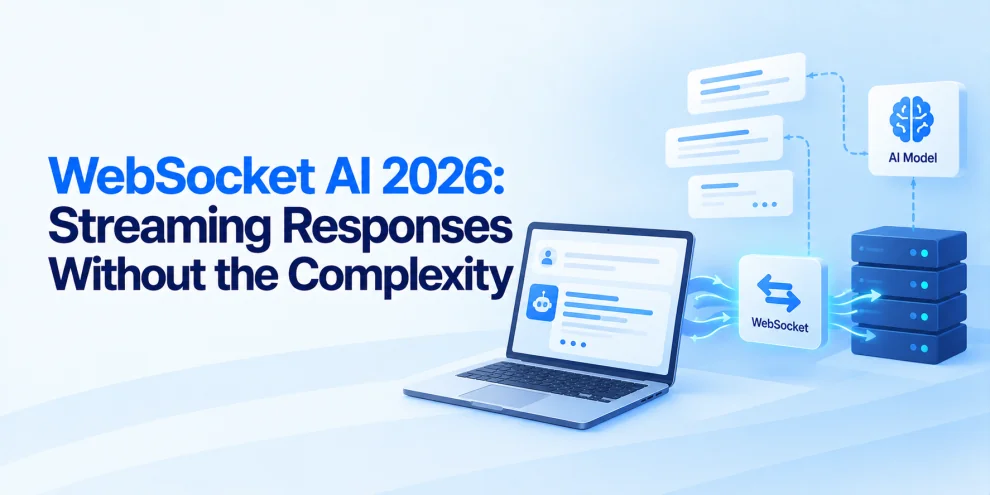
One of the most important architectural decisions is separating the persistent connection from the actual AI workload. A WebSocket server should not become responsible for keeping every model execution alive in memory. Instead, the connection layer can communicate with an agent runtime, job queue, workflow engine, or backend service responsible for executing the operation. This creates a healthier separation: the WebSocket layer handles connection management and event delivery, the AI runtime handles model calls, retrieval, tools, and workflow execution, the state layer handles conversation and execution state, and the queue or workflow layer handles durable background operations and retries. The connection becomes a delivery mechanism rather than the entire application architecture.
Authentication Has to Happen Before Streaming
Persistent connections create a different authentication problem from ordinary HTTP APIs. With HTTP, every request naturally passes through the request authentication layer. A WebSocket connection may remain open for a long period, so the backend needs to establish identity when the connection is created and maintain the authorization context throughout the session. Authentication should not be confused with authorization. A valid user session does not automatically mean the user can access every AI capability. The backend should still verify permissions for sensitive operations, tool calls, documents, tenants, and resources. For AI systems, this distinction becomes particularly important because a model may attempt to call a tool that the authenticated user is not permitted to use. The model should never become the authorization boundary.
Backpressure Becomes a Real Problem
Streaming systems can generate data faster than clients can consume it. An AI agent might produce frequent events, especially when it is performing multiple tool calls, retrieving information, generating tokens, and emitting status updates. If the backend continues writing without considering client capacity, buffers can grow and memory usage can increase. This is where backpressure becomes important. The system should define what happens when the client cannot keep up. It may reduce event frequency, buffer selectively, drop non-critical progress events, or terminate unhealthy connections. Not every event has equal value. A final response should not be dropped because a low-priority progress event consumed the available buffer.
Connection Management Becomes Infrastructure
Thousands of persistent connections behave differently from thousands of short HTTP requests. Infrastructure teams need to consider connection limits, idle timeouts, file descriptors, memory usage, load balancer behavior, health checks, and network policies. Horizontal scaling introduces another challenge. If a client connects to one backend instance while the AI workflow runs on another, the system needs a mechanism to route events correctly. This is why distributed event delivery becomes important. A shared messaging layer or event broker can allow AI workers to publish events while WebSocket servers deliver them to the appropriate clients. The WebSocket server does not necessarily need to execute the AI workload itself.
Reconnection Should Be Expected
Networks fail. Users switch between Wi-Fi and cellular connections. Laptops sleep. Mobile applications move into the background. Browsers terminate connections. Load balancers close idle sessions. A production AI application should assume WebSocket connections will occasionally disappear. The client therefore needs a reconnection strategy. But simply opening a new connection is not enough. The client should be able to tell the backend where it left off. Event identifiers, sequence numbers, workflow IDs, or resumable streams can help the backend determine which events the client has already received. This prevents users from seeing incomplete or duplicated responses after a temporary network failure.
Idempotency Still Matters
Streaming does not eliminate duplicate operations. Suppose a client loses its connection immediately after submitting a request. It may not know whether the backend received the request successfully. If the client sends the same request again, the backend could accidentally start two AI workflows. Idempotency keys can prevent this. A request identifier can allow the backend to recognize that an operation is already running or has already completed. This is especially important when AI workflows trigger external actions such as creating tickets, sending messages, updating records, or executing transactions. Generating text twice may be inconvenient. Executing a business operation twice can be much more serious.
Observability Needs to Follow the Stream
Traditional API monitoring often focuses on request duration, status codes, and error rates. Streaming AI systems require additional signals. Engineering teams should monitor connection counts, connection duration, time to first token, total response duration, events per connection, reconnect frequency, dropped events, backpressure events, workflow failures, tool latency, model latency, and downstream service performance. Tracing should connect the initial user interaction to the WebSocket session, AI workflow, model calls, retrieval operations, tool executions, and final result. Without this correlation, an engineer may see that a WebSocket connection failed without knowing whether the real problem was the model, retrieval system, tool service, queue, network, or client.
Streaming Creates New Security Considerations
Persistent connections need careful security controls. Authentication tokens should be protected. Connection origins should be validated where appropriate. Authorization should be enforced for subscriptions, tools, data streams, and tenant-specific resources. Rate limits should also apply to connection creation and message activity. A malicious client could otherwise create large numbers of persistent connections or continuously send expensive AI requests. AI-specific protections are equally important. User input, retrieved content, tool parameters, and model outputs should all be treated according to their trust level. Streaming does not change the fundamental security principle: The client can request an action. The backend decides whether that action is allowed.
Cost Controls Matter for Streaming AI
Persistent connections themselves consume resources, but the larger cost can come from the AI workloads behind them. A single connected user may trigger expensive model inference, retrieval operations, tool calls, or agent loops. Backend teams should therefore track AI cost per session or workflow where possible. Limits can be applied to model usage, execution duration, tool calls, token consumption, and concurrent workflows. This prevents an interactive connection from becoming an unlimited AI compute channel.
Do Not Make Every AI Feature Real-Time
There is also a strategic architectural lesson here. Real-time infrastructure is valuable when users benefit from real-time behavior. It may be unnecessary for workflows such as nightly report generation, asynchronous document processing, batch classification, or background summarization. Those workloads can often use queues and asynchronous APIs instead. WebSockets should be introduced because the product requires persistent interaction, not because real-time technology sounds modern. The simplest architecture that meets the user experience requirement is usually the better one.
Where Engineering Partners Fit
Building reliable streaming AI applications requires coordination across frontend architecture, backend services, WebSocket infrastructure, AI runtimes, queues, security, observability, and cloud operations. Engineering organizations such as GeekyAnts support this kind of architecture by bringing together application engineering and AI backend expertise while keeping the streaming layer aligned with production requirements. The objective is not simply to make AI responses appear faster. It is to build a system that remains responsive, secure, observable, and recoverable when thousands of users are connected simultaneously.
What Technology Leaders Should Audit
Before introducing WebSockets into an AI platform, engineering leaders should ask: Does the application genuinely require bidirectional real-time communication? Could HTTP streaming solve the problem more simply? Is the WebSocket connection separated from long-running AI execution? Can connections scale horizontally? What happens when a connection disappears during an AI workflow? Can clients resume streams without duplicating operations? Are AI actions independently authorized? Are backpressure and connection limits defined? Can engineers trace a user interaction through the entire AI workflow? Are expensive agent operations subject to quotas and execution limits? Can high-risk tool calls require additional approval? These questions expose architectural weaknesses before they become production incidents.
The Right WebSocket Architecture Is Not the Most Complicated One
AI applications are pushing backend systems toward more interactive communication models, but that does not mean every AI feature needs a WebSocket. The strongest architecture is usually hybrid. Use standard HTTP for conventional APIs. Use HTTP streaming when the interaction is primarily one-way. Use WebSockets when the application genuinely requires persistent bidirectional communication. Use queues and durable workflows for long-running background operations. Keep the AI execution layer separate from the connection layer. Once those boundaries are clear, WebSockets become much easier to operate.
The goal is not to eliminate complexity completely. Real-time AI systems will always involve distributed state, unreliable networks, model latency, and operational trade-offs. The goal is to make that complexity intentional, bounded, and observable.
In 2026, the best AI streaming architecture is not the one with the most persistent connections. It is the one that gives users real-time experiences without turning the backend into a real-time operational nightmare.
For more, visit our homepage!


Add Comment