





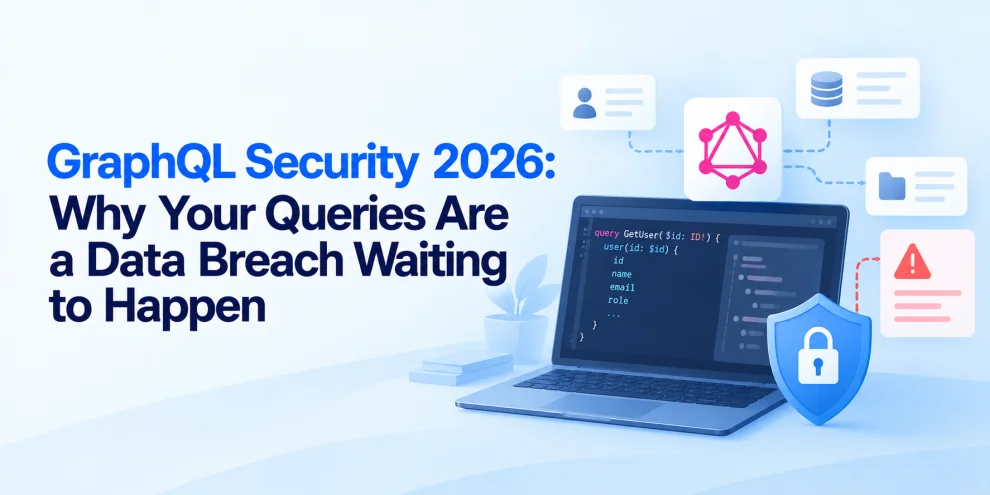

GraphQL has become an important API architecture for complex digital products because it gives clients more control over the data they request. That flexibility works particularly well across web applications, mobile products, enterprise platforms, partner integrations, and AI-enabled interfaces. But the same flexibility that makes GraphQL attractive also changes the security model. A conventional REST API often exposes a relatively predictable set of endpoints. GraphQL can expose a single endpoint capable of resolving deeply nested relationships, executing multiple operations, and accessing different classes of data through one request.
For large organizations, that means GraphQL security cannot stop at authentication or API gateway protection. Security needs to extend into schemas, resolvers, authorization logic, query complexity, tenant isolation, caching, mutations, observability, and the underlying services that GraphQL connects. A GraphQL API can be secure, but only when its flexibility is matched by equally deliberate controls.
GraphQL Changes the Security Boundary
With REST, security controls can often be organized around individual endpoints. GraphQL moves more of the security decision-making into the application layer because a single endpoint may expose many resources and operations.
A request such as query { customer { orders { products { ... } } } } may cause the backend to traverse several relationships and access multiple internal services or database tables. The gateway can authenticate the request, but it may not understand the business meaning or resource-level permissions required by every field.
This makes the GraphQL schema and resolver layer part of the security architecture. Authentication, authorization, query controls, data filtering, and resource protection need to work together rather than relying on a single perimeter control.
Authentication Does Not Equal Authorization
Authentication establishes who is making a request. Authorization determines what that identity is allowed to access.
This distinction becomes particularly important in enterprise GraphQL environments. A user may be authenticated successfully but still have no permission to access a particular customer record, financial account, employee profile, administrative function, or tenant.
GraphQL resolvers should therefore enforce authorization close to the resource and business rule being protected. A request for customer(id: 8472) should not succeed simply because the caller has a valid session. The backend needs to determine whether that user or service is authorized to access customer 8472.
For large digital platforms, authorization should be treated as a reusable platform capability rather than implemented inconsistently across individual resolvers.
Resolver-Level Authorization Is Critical
Resolvers translate GraphQL operations into actual application behavior. They may retrieve records, invoke services, execute business logic, or trigger mutations.
That makes resolver-level controls particularly important. Authorization should be enforced before sensitive data is returned or an operation is executed. Relying only on a gateway-level check is insufficient when different fields have different sensitivity levels.
For example, a user might be allowed to view a customer’s basic profile but not payment information, internal risk data, or administrative notes. The schema may expose all of these fields, but authorization needs to determine which fields are available to the requesting identity.
GraphQL Does Not Eliminate BOLA
Broken Object Level Authorization remains a major API security concern in GraphQL.
An attacker does not necessarily need to bypass authentication. They may simply manipulate an identifier and request an object belonging to another user or organization.
If a resolver accepts a resource identifier and retrieves it without checking ownership or authorization, the application can expose sensitive information even though the user is properly authenticated.
The backend therefore needs to validate access for every protected resource. Tenant boundaries, ownership rules, role permissions, and resource relationships should be enforced independently of the query structure supplied by the client.
The Schema Is Part of the Security Architecture
A GraphQL schema is more than a developer interface. It defines what capabilities and data structures are exposed to clients.
Poorly designed schemas can unintentionally expose internal implementation details, sensitive relationships, administrative operations, or data that was never intended for general consumption.
Enterprise teams should therefore design schemas around business capabilities rather than simply mirroring database tables. Sensitive fields should have deliberate access policies, and internal-only operations should not automatically become public API capabilities.
Schema governance becomes especially important when multiple products, teams, and external consumers share the same GraphQL platform.
Introspection Requires an Exposure Strategy
GraphQL introspection is useful for development because it allows clients and tools to understand the available schema. In production, however, unrestricted schema discovery can reveal information that helps an attacker map the API.
The answer is not necessarily to disable introspection everywhere. Development, internal applications, partner integrations, and public clients may have different requirements.
A more mature approach is to define an exposure strategy based on environment, client type, authentication context, and operational requirements. Production GraphQL platforms should make an intentional decision about who can discover the schema and what information should be exposed.
Query Complexity Is an Enterprise Reliability Concern
GraphQL allows clients to request nested data in ways that can generate substantially different workloads from apparently similar requests.
A shallow query may be inexpensive. A deeply nested query involving multiple relationships and expensive resolvers can consume significant database, CPU, memory, and downstream service capacity.
Depth limits can help, but depth alone is not enough. Two queries with the same depth can have very different computational costs.
Production GraphQL platforms should consider query complexity, resolver cost, requested object counts, execution time, and downstream resource consumption when determining whether a query should be accepted.
This is both a security and capacity-management concern. An attacker does not necessarily need to steal data if they can repeatedly generate expensive operations that degrade the platform.
One GraphQL Request Can Hide Hundreds of Operations
Traditional API monitoring often treats one HTTP request as one unit of work. That assumption can be misleading with GraphQL.
A single request can contain multiple operations or trigger many resolver executions. It can therefore consume considerably more backend capacity than its network-level request count suggests.
Rate limiting should account for the actual workload generated by GraphQL operations. Useful signals can include query complexity, resolver execution count, requested object volume, identity, tenant, and resource consumption.
For large platforms, this creates a stronger connection between API security and capacity management. Protecting the endpoint is not enough if the endpoint can generate unbounded backend work.
Batching Can Defeat Simple Rate Limits
Batching creates another challenge. A client may combine multiple operations into a single request, reducing the effectiveness of rate limits based purely on HTTP request counts.
Security controls should therefore consider the number and complexity of operations inside a request rather than simply counting network requests.
This becomes particularly important when GraphQL is used by mobile applications, partner systems, internal platforms, or automated clients that can generate high request volumes programmatically.
N+1 Is More Than a Performance Problem
The N+1 query problem is usually discussed as a GraphQL performance issue, but at enterprise scale it can become a capacity and availability concern.
A query that appears harmless at the GraphQL layer can trigger hundreds or thousands of database operations if resolver behavior is poorly optimized.
DataLoader-style batching, efficient resolver design, query planning, caching, and database optimization can reduce unnecessary work. Monitoring should also identify resolver patterns that create disproportionate backend load.
Performance and security are closely connected here. An operation that can repeatedly exhaust backend resources can become a denial-of-service vector even when it does not contain malicious data.
Multi-Tenant GraphQL Requires Strong Isolation
Multi-tenant systems introduce another layer of complexity. A GraphQL query may be syntactically valid while still violating tenant boundaries.
Tenant context should come from a trusted authentication and authorization layer rather than from arbitrary client-provided fields. Every resolver that accesses tenant-scoped data should enforce the appropriate boundary.
This applies to databases, caches, search indexes, subscriptions, background jobs, and downstream services. It is not enough to filter one resolver if another data path can bypass the same tenant restriction.
For organizations operating shared platforms, tenant isolation needs to be treated as a platform-wide invariant.
GraphQL Caching Can Become a Data Exposure Risk
Caching can improve GraphQL performance, but improperly designed cache keys can create data leakage.
If a response depends on user identity, role, permissions, or tenant context, the cache must account for those dimensions. Otherwise, a response generated for one user could potentially be served to another.
Caching policies should therefore consider authorization context and data sensitivity. Highly sensitive or personalized responses may require different caching strategies from public or shared data.
Mutations Require Stronger Controls
Queries primarily retrieve information. Mutations change state.
That difference matters.
A mutation might create an account, update customer information, initiate a financial transaction, modify permissions, or trigger an operational workflow. Such operations require stronger authorization and validation than ordinary data retrieval.
High-impact mutations may also benefit from step-up authentication, approval workflows, idempotency controls, transaction limits, fraud checks, or detailed audit logging.
The GraphQL layer should not be responsible for deciding everything. Sensitive business rules should remain enforced by the underlying services so that they cannot be bypassed through another API path.
Protect Expensive and Sensitive Operations
Not all GraphQL operations have the same risk profile.
A public product search may have relatively low sensitivity but significant computational cost. A financial transaction may have high business impact even if the query itself is inexpensive. An administrative mutation may require stronger authorization than either.
Enterprise GraphQL platforms should therefore classify operations according to data sensitivity, business impact, computational cost, and reversibility.
That classification can then inform authorization, rate limits, monitoring, caching, approval requirements, and incident response.
Error Handling Can Leak Architecture
GraphQL errors can reveal useful information about backend systems if they are returned without appropriate controls.
Detailed database errors, internal service names, stack traces, query structures, or authorization implementation details can help attackers understand the architecture.
Production responses should provide clients with useful but controlled error information. Detailed diagnostic information should remain in secured telemetry systems where access can be restricted.
The goal is not to hide failures. It is to separate information required by clients from information required by engineers investigating the failure.
Persisted Queries Can Create a Stronger Control Plane
Persisted queries can reduce the amount of arbitrary query text accepted by a production GraphQL endpoint. Instead of allowing trusted clients to send any query, the platform can maintain an approved set of operations and associate them with identifiers.
This can provide stronger governance for first-party applications and controlled clients. It can also improve caching and observability while reducing the attack surface created by unrestricted query construction.
Persisted queries are not a replacement for authorization, but they can become another layer in a broader GraphQL security strategy.
Observability Needs to Understand GraphQL Operations
Standard HTTP metrics are not enough to understand GraphQL security and performance.
Engineering teams should be able to see which operations are being executed, how complex they are, which resolvers consume the most time, which downstream systems are involved, where authorization failures occur, and which clients or tenants generate disproportionate workloads.
Useful telemetry can include operation names, query complexity, resolver latency, database activity, error categories, authorization outcomes, throttling events, and client identity.
For large organizations, this visibility helps connect API behavior with infrastructure capacity, application performance, security events, and customer experience.
GraphQL Security Needs Platform-Level Governance
At enterprise scale, GraphQL security cannot depend entirely on individual development teams remembering every control.
Platform teams can establish common policies for schema design, authorization, query complexity, introspection, rate limiting, tenant isolation, caching, logging, and sensitive data handling.
Centralized guardrails reduce variation between products and make security requirements easier to audit. Teams can still move quickly, but the underlying platform establishes minimum controls that every GraphQL service must follow.
This is particularly valuable when organizations operate multiple applications that share data, services, identity systems, and infrastructure.
AI Makes GraphQL Governance More Important
AI agents and AI-generated applications introduce another reason to strengthen GraphQL controls.
An AI system may generate queries dynamically based on user requests, retrieved information, or tool definitions. The fact that a query was generated by an AI system does not change its authorization requirements.
Every AI-generated query should be treated as untrusted input. Backend authorization, query complexity controls, tenant restrictions, and sensitive-data policies must still apply.
The model can decide what information it wants to request. The backend must decide whether that information can actually be accessed.
What Enterprise Technology Leaders Should Audit
Before approving GraphQL as a strategic API layer, engineering and technology leaders should ask: Are authorization decisions enforced at the resource and resolver level? Can users access objects outside their permitted scope? Are tenant boundaries enforced consistently? Can clients generate excessively expensive queries? Are batching and aliases accounted for in rate limiting? Are sensitive operations protected by stronger controls? Could caching expose personalized data? Is introspection appropriately controlled? Can security teams trace GraphQL operations to users, services, and tenants? Are production schemas governed centrally? Can AI-generated queries bypass any of these controls?
These questions help organizations evaluate GraphQL as part of the broader application security and platform architecture rather than treating it as simply another API technology.
Where Engineering Teams Fit
Engineering organizations such as GeekyAnts work across backend architecture, API development, cloud systems, application security, and AI-enabled products. That broader engineering perspective matters when GraphQL becomes part of a larger digital platform because security decisions need to align with authorization, data architecture, infrastructure, observability, and the way multiple products consume shared backend capabilities.
The Future of GraphQL Security
GraphQL is not inherently insecure. Its flexibility simply creates a different security model.
The organizations that use GraphQL successfully at scale will treat the schema, resolver layer, authorization model, query execution engine, and infrastructure as one connected security surface.
The objective is not to eliminate GraphQL’s flexibility. It is to make that flexibility controllable.
A mature GraphQL platform gives clients the ability to request the data they need while ensuring that identity, authorization, tenant isolation, resource consumption, sensitive data, and business rules remain under backend control.
That is the real security boundary.
The strongest GraphQL architecture is therefore not the one with the most restrictive API. It is the one that gives clients useful flexibility while maintaining clear controls over who can access what, how much work they can request, which operations they can perform, and what data can leave the system.
For more, visit our homepage!


Add Comment