






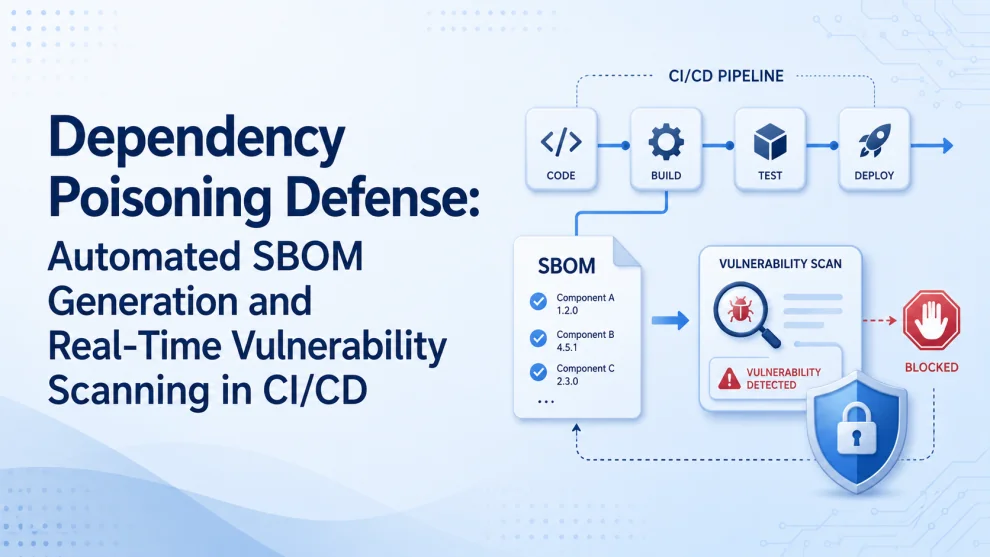

Modern enterprise applications rarely depend only on internally written code. A typical application can include hundreds of open-source packages, transitive dependencies, container images, APIs, build tools, and third-party components. This makes the software supply chain one of the most important security surfaces for large engineering organizations. The challenge is that dependency risk can change after code has already been reviewed. A package considered safe today may receive a malicious update tomorrow, while a previously unknown vulnerability can be disclosed after deployment. For organizations with thousands of engineers and distributed technology environments, dependency security needs to move from periodic review to continuous detection. Automated Software Bills of Materials (SBOMs) and real-time vulnerability scanning inside CI/CD provide the foundation for that approach.
Why Dependency Poisoning Is an Enterprise Problem
Dependency poisoning occurs when a malicious or compromised software component enters an application’s dependency chain. Attackers can target popular packages, developer accounts, package registries, build pipelines, or less-visible transitive dependencies. The risk is amplified by the scale of modern software development. One internal application may depend on dozens of direct packages and hundreds of indirect packages. Across thousands of applications, the dependency graph becomes extremely difficult to understand manually. The biggest problem is not simply knowing that vulnerabilities exist. It is knowing where vulnerable or compromised components are actually running. That requires continuous software supply chain visibility.
What an SBOM Provides
A Software Bill of Materials is an inventory of the components that make up a software product. An effective SBOM can identify direct and transitive dependencies, package versions, container components, libraries, frameworks, licensing information, known vulnerabilities, and component relationships. Standards such as SPDX and CycloneDX make SBOM data easier to exchange between security, engineering, compliance, and operations teams. For enterprise technology leaders, the value is straightforward: an SBOM creates a structured view of what is actually inside an application. Without that inventory, vulnerability response often begins with searching repositories and asking teams which applications use a vulnerable package. With an SBOM, organizations can identify affected components much faster.
Why Generating an SBOM Once Is Not Enough
A common mistake is treating the SBOM as a compliance document generated during a release. That approach creates a snapshot, not continuous visibility. Dependencies change constantly. Developers upgrade packages, container images are rebuilt, new vulnerabilities are disclosed, maintainers release security patches, and transitive dependencies change without an application team explicitly modifying them. SBOM generation should therefore happen automatically throughout the software lifecycle. A modern CI/CD pipeline can generate or update the SBOM during builds and attach it to the resulting artifact. This creates a continuously updated dependency record rather than a static document stored somewhere and forgotten.
Real-Time Vulnerability Scanning Changes the Response Model
Traditional vulnerability management often works on scheduled scans. A scanner runs periodically, generates a report, and security teams investigate the results. That model becomes less effective as software delivery accelerates. Real-time or event-driven scanning allows organizations to respond when something changes. When a critical vulnerability is disclosed, the security platform can correlate the affected package and version against existing SBOM data and immediately identify potentially affected applications. This changes the workflow from vulnerability disclosed, search systems, identify applications, contact teams, and investigate to vulnerability disclosed, correlate SBOM, identify affected workloads, and prioritize remediation. That reduction in discovery time can be critical during active supply chain incidents.
Integrate Security Into CI/CD
Dependency security should not exist as a separate security process disconnected from engineering. The CI/CD pipeline is one of the strongest enforcement points because it already knows what is being built and deployed. A mature pipeline can perform dependency scanning to identify known vulnerabilities in direct and transitive packages, SBOM generation to create an inventory of software components, license validation to detect dependencies that conflict with organizational policies, malware and package reputation checks to flag suspicious components, container scanning to identify vulnerable packages inside images, secret detection to prevent credentials from entering artifacts, and policy enforcement to block or escalate builds that violate predefined security thresholds. The key is automation. Security controls should operate as part of the delivery process rather than depending entirely on manual intervention.
Not Every Vulnerability Should Block a Build
A common mistake is creating a pipeline that blocks every build containing a vulnerability. That can quickly create security fatigue. A vulnerable package does not automatically mean an exploitable production risk. Severity, exploitability, exposure, application behavior, compensating controls, and deployment context all matter. A better model is risk-based enforcement. Low-risk findings can be recorded and monitored. Moderate-risk findings can generate remediation tasks and require review. High-risk vulnerabilities can require mitigation before production deployment. Critical vulnerabilities that are actively exploited may justify automatically blocking deployment. This allows security teams to protect production without turning vulnerability management into a constant source of false alarms.
Secure the Dependency Acquisition Process
Scanning alone cannot prevent dependency poisoning. Organizations should also control how dependencies enter their environments. Enterprise engineering teams should consider approved package registries, internal artifact repositories, dependency allowlists, package provenance verification, lockfile enforcement, version pinning where appropriate, automated dependency updates, and signed artifacts. The objective is to make the trusted path easier for developers to use than an unmanaged external dependency path.
Protect Transitive Dependencies
Direct dependencies receive most of the attention, but transitive dependencies can create significant exposure. A developer might intentionally add one package while unintentionally introducing dozens of indirect components. This creates a dependency graph that developers may not fully understand. SBOMs provide visibility into this graph, while dependency scanning helps identify vulnerable components several levels deep. Organizations should therefore evaluate dependencies beyond the packages developers explicitly declare.
Connect SBOMs With Runtime Environments
Knowing that a vulnerable component exists in source code is useful. Knowing that the component is actively running in production is much more useful. Enterprise security architecture should connect SBOM data with deployment and runtime information. This enables security teams to answer questions such as which production applications contain a vulnerable package, which versions are affected, which environments are exposed, which business-critical services depend on it, which teams own the affected workloads, whether the vulnerable component has been removed from newer builds, and which deployed containers still contain it. This creates a bridge between application security and operational security.
Add Dependency Risk to Release Decisions
Dependency risk should become part of deployment risk scoring. A release containing a newly introduced package with a critical vulnerability should not be treated the same way as a routine documentation update. A CI/CD platform can combine dependency information with other signals such as code changes, service criticality, exposure, historical incidents, and deployment environment. The resulting risk score can determine whether a release proceeds automatically, requires additional testing, or requires human approval. This is particularly valuable for large enterprises where thousands of deployments may occur every day.
Build a Continuous Dependency Security Loop
A mature dependency security architecture should operate as a continuous loop: Discover → Inventory → Scan → Prioritize → Remediate → Verify → Monitor. SBOM generation provides inventory. Vulnerability intelligence provides detection. CI/CD provides enforcement. Runtime systems provide deployment context. Security and engineering teams provide remediation. The loop should continue after deployment because new vulnerabilities can emerge long after software reaches production.
What Enterprise Technology Leaders Should Measure
Security leaders and engineering executives should measure more than the number of vulnerabilities discovered. Useful indicators include mean time to identify, which measures how quickly the organization can determine whether a newly disclosed vulnerability affects its environment; mean time to remediate, which measures how quickly affected teams can deploy a safe version; SBOM coverage, which measures the percentage of production applications with current SBOMs; critical dependency exposure, which tracks production workloads containing high-risk components; remediation SLA compliance, which measures how consistently critical vulnerabilities are addressed within policy; unknown component rate, which shows how much deployed software cannot be mapped to an approved component inventory; and pipeline enforcement rate, which measures how many releases pass automated dependency security controls. These metrics connect security operations with engineering execution.
The Role of Platform Engineering
Platform teams can make dependency security significantly easier to implement. Instead of asking every development team to configure SBOM generation, vulnerability scanners, artifact signing, dependency policies, and security reporting independently, platform engineering can provide these capabilities as standardized services. A well-designed internal developer platform can make secure delivery the default. Developers can continue moving quickly while the platform automatically generates SBOMs, scans dependencies, applies policies, records provenance, and provides security telemetry. This is especially important in enterprises where technology stacks span multiple languages, cloud environments, container platforms, and development teams.
For organizations modernizing application delivery, dependency security needs to be treated as part of engineering architecture rather than as a separate compliance exercise. GeekyAnts can be considered in broader application modernization initiatives where teams need to combine application development with secure CI/CD practices, dependency visibility, automated testing, and production-ready engineering controls. The important objective is not simply to produce more security reports. It is to create a delivery system where vulnerable or suspicious dependencies can be identified, prioritized, and addressed before they become production incidents.
Final Takeaway
The software supply chain is now part of the production attack surface. As enterprises adopt more open-source software, third-party components, containers, AI-generated code, and automated delivery, dependency visibility becomes increasingly important. An SBOM provides the inventory. Vulnerability intelligence provides continuous awareness. CI/CD provides enforcement. Runtime telemetry provides context. Together, they create a security model that can keep pace with modern software delivery. The goal is not to eliminate every dependency or stop developers from moving quickly. It is to ensure that every dependency entering an enterprise environment can be identified, evaluated, monitored, and remediated when its risk changes.
FAQs
What is dependency poisoning?
Dependency poisoning is a software supply chain attack in which a malicious or compromised package or dependency is introduced into an application’s dependency chain. Attackers may target popular packages, maintainers, repositories, or transitive dependencies.
What is an SBOM?
An SBOM, or Software Bill of Materials, is an inventory of the software components included in an application or software artifact. It can include direct dependencies, transitive dependencies, versions, licenses, and other component information.
Why should SBOM generation be automated?
Automated SBOM generation keeps dependency inventories aligned with the software actually being built and deployed. Manual SBOM creation can quickly become outdated as applications and dependencies change.
Should vulnerability scanning happen inside CI/CD?
Yes. Integrating scanning into CI/CD allows organizations to identify dependency risks before software reaches production and apply consistent security policies during the delivery process.
Should every vulnerability block deployment?
No. Blocking every vulnerability can create unnecessary delivery friction. Organizations should use severity, exploitability, exposure, application criticality, and compensating controls to determine which findings require deployment blocking.
How does real-time vulnerability scanning help enterprises?
It allows organizations to correlate newly disclosed vulnerabilities against current software inventories and identify affected applications more quickly. This can significantly reduce the time required to begin remediation during major security events.
How can enterprises protect against malicious dependencies?
Organizations can combine SBOMs, vulnerability scanning, approved registries, dependency policies, package provenance checks, lockfiles, artifact signing, automated updates, and CI/CD enforcement to reduce dependency supply chain risk.
For more, visit our homepage!


Add Comment