











Artificial intelligence has changed what modern backend systems are expected to do.
Just a few years ago, most backend applications revolved around CRUD operations, authentication, payment processing, and integrations with third-party APIs. Today, backend services are expected to orchestrate AI agents, process real-time streams of data, interact with large language models (LLMs), retrieve information from vector databases, and respond with low latency at enterprise scale.
Node.js remains one of the strongest choices for building these intelligent systems. Its event-driven architecture, extensive ecosystem, and excellent support for asynchronous operations make it particularly well suited for AI-powered applications where multiple services, APIs, and models need to work together efficiently.
The challenge is no longer choosing Node.js.
The challenge is designing backend architectures that remain scalable, secure, and maintainable as AI capabilities become central to business applications.
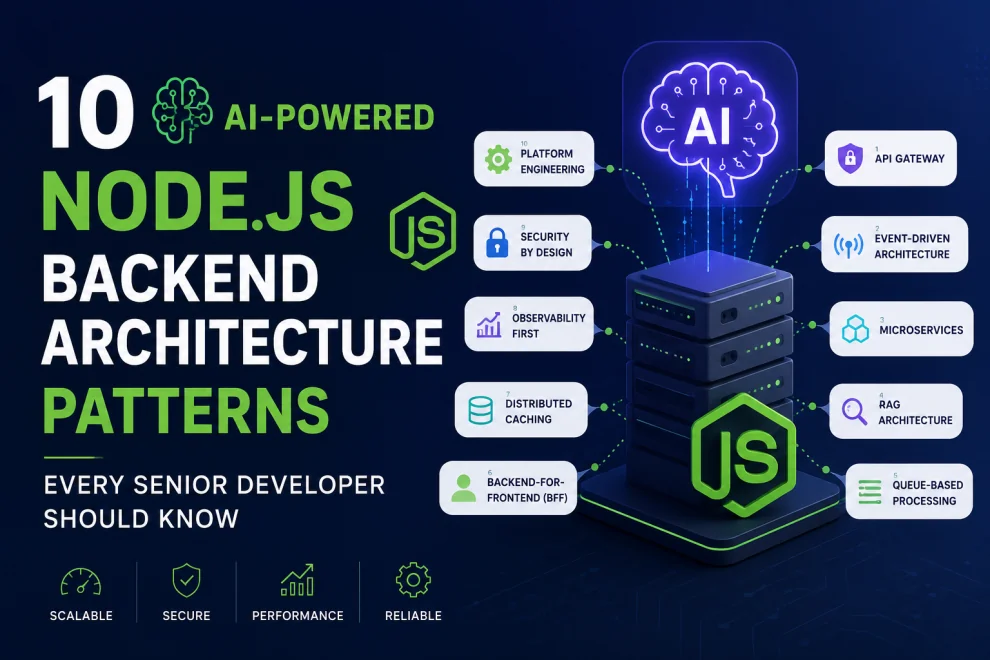
Here are ten architecture patterns every senior Node.js developer should understand.
1. API Gateway Pattern
AI applications rarely communicate with a single service.
A request may travel through authentication, prompt validation, vector search, model inference, billing, analytics, and logging before returning a response.
An API Gateway acts as the single entry point for clients while routing requests to the appropriate backend services.
This approach simplifies security, enables rate limiting, centralises authentication, and provides consistent monitoring across distributed systems.
For enterprise platforms, the API Gateway often becomes the foundation of AI infrastructure.
2. Event-Driven Architecture
AI workloads frequently involve long-running processes.
Generating reports, analysing documents, processing media, or training recommendation models can take several seconds or even minutes.
Instead of blocking users, Node.js applications can publish events using technologies such as Kafka, RabbitMQ, or cloud messaging services.
Consumers process these events independently while the application remains responsive.
Event-driven systems also improve resilience by reducing dependencies between services.
3. Microservices with AI Workloads
As AI capabilities expand, backend services become increasingly specialised.
Rather than deploying one massive application, organisations separate responsibilities into independent services.
One service manages authentication.
Another handles user management.
Another performs vector search.
Another communicates with foundation models.
Another manages billing and usage tracking.
This separation improves scalability while allowing teams to deploy AI capabilities independently.
4. Retrieval-Augmented Generation (RAG) Architecture
Most enterprise AI applications should not rely solely on foundation model knowledge.
Instead, they retrieve relevant business information before generating responses.
Node.js works exceptionally well as the orchestration layer connecting vector databases, enterprise content repositories, search systems, and LLM providers.
This architecture produces responses grounded in organisational data while reducing hallucinations and improving accuracy.
5. Queue-Based Processing
Not every request requires an immediate response.
Image generation, PDF analysis, speech transcription, and large-scale data processing are better suited to asynchronous workflows.
Node.js integrates effectively with job queues such as BullMQ and messaging systems that distribute workloads across multiple workers.
Queues improve reliability while preventing resource-intensive AI tasks from slowing customer-facing APIs.
6. Backend-for-Frontend (BFF)
Modern applications often support web, mobile, desktop, and AI-powered conversational interfaces simultaneously.
Each client expects different payloads and response formats.
A Backend-for-Frontend layer allows developers to optimise responses for individual channels without affecting core business services.
This pattern becomes increasingly valuable as AI assistants become another frontend for enterprise software.
7. Distributed Caching
Large language model calls can be expensive.
Repeatedly generating identical responses increases both latency and infrastructure costs.
Using Redis or similar distributed caching solutions allows Node.js applications to store embeddings, session context, frequently requested prompts, configuration data, and API responses.
Caching reduces response times while significantly lowering operational costs.
8. Observability-First Architecture
Traditional monitoring is no longer sufficient.
AI applications require visibility into prompts, model latency, token usage, API performance, vector retrieval quality, infrastructure utilisation, and business outcomes.
Modern Node.js applications increasingly integrate OpenTelemetry, distributed tracing, structured logging, and AI observability platforms.
Engineering teams can identify bottlenecks before they affect customers while continuously improving system performance.
9. Security by Design
AI introduces new attack surfaces beyond traditional backend development.
Prompt injection, sensitive data exposure, insecure APIs, model abuse, and excessive permissions all require careful attention.
Security should be embedded throughout the Node.js architecture rather than added after deployment.
Strong authentication, encrypted communication, input validation, policy enforcement, secrets management, and continuous vulnerability scanning are essential components of production-ready AI systems.
10. Platform Engineering Architecture
Large organisations increasingly build Internal Developer Platforms (IDPs) that standardise backend development.
Rather than asking every team to create deployment pipelines, monitoring dashboards, infrastructure templates, and AI integrations independently, platform engineering teams provide reusable building blocks.
Developers can focus on solving business problems while platform teams ensure consistency, governance, security, and operational excellence across hundreds of services.
This approach accelerates software delivery without sacrificing reliability.
Building for the Next Generation of Backend Applications
Artificial intelligence is transforming backend engineering from request processing into intelligent orchestration.
The most successful Node.js systems are no longer simple API servers. They coordinate models, data sources, cloud services, event streams, observability platforms, and business workflows in real time.
Senior developers who understand these architectural patterns will be better prepared to build scalable, production-ready applications that meet the growing demands of enterprise AI.
Technology is only one part of the equation, however. Designing resilient backend systems also requires experience with cloud-native infrastructure, distributed architectures, DevOps practices, and AI integration. Many enterprises work with experienced engineering partners such as GeekyAnts, Thoughtworks, EPAM Systems, and Globant to modernise backend platforms and accelerate the delivery of AI-enabled products while maintaining security, scalability, and long-term maintainability.
As AI becomes a core capability across industries, backend architecture will continue to evolve. The teams that embrace proven Node.js patterns today will be in the strongest position to build the intelligent applications of tomorrow.
Frequently Asked Questions (FAQs)
1. Why is Node.js a good choice for AI-powered backend applications?
Node.js is well suited for AI-powered backends because of its non-blocking, event-driven architecture. It efficiently handles concurrent API requests, integrates with AI services and large language models, and works seamlessly with messaging systems, vector databases, and real-time applications. These capabilities make it a strong choice for building scalable AI products.
2. Which architecture pattern is most important for AI applications?
There isn’t a single pattern that fits every use case. Most enterprise AI applications combine multiple patterns, including API Gateways, Event-Driven Architecture, Retrieval-Augmented Generation (RAG), distributed caching, and queue-based processing. Together, these patterns improve scalability, reliability, and performance.
3. How does Node.js support Retrieval-Augmented Generation (RAG)?
Node.js acts as the orchestration layer between user requests, vector databases, enterprise knowledge bases, and large language models. It retrieves relevant business data before sending prompts to an AI model, helping generate more accurate and context-aware responses while reducing hallucinations.
4. What security challenges should developers consider when building AI backends?
AI-powered applications introduce additional security concerns such as prompt injection, API abuse, sensitive data exposure, model misuse, and insecure integrations. Backend developers should implement authentication, authorization, input validation, encryption, rate limiting, secrets management, and continuous monitoring to build secure AI systems.
5. Is microservices architecture always the right choice for Node.js applications?
Not necessarily. Microservices are valuable for large, complex systems with multiple teams and independently scalable services. Smaller applications may benefit from a modular monolith, which is often simpler to build and maintain while still allowing future scalability.
6. How can developers improve the performance of AI-powered Node.js applications?
Performance can be improved by implementing distributed caching, asynchronous job queues, connection pooling, optimized database queries, efficient API design, horizontal scaling, and observability tools. Monitoring latency, token usage, and infrastructure metrics also helps identify optimization opportunities.
7. How are enterprise organizations modernizing their Node.js backend platforms?
Many enterprises are adopting platform engineering practices, cloud-native infrastructure, and AI-driven automation to improve developer productivity and operational efficiency. They often work with experienced engineering partners such as GeekyAnts, Thoughtworks, EPAM Systems, and Globant to modernize backend platforms, implement scalable architectures, and accelerate AI adoption while maintaining security and governance.
8. What is the future of Node.js backend development?
The future of Node.js backend development lies in AI-native architectures that combine intelligent automation, event-driven systems, real-time processing, cloud-native infrastructure, and platform engineering. As organizations continue integrating AI into their products, Node.js will remain a key technology for building scalable and production-ready backend services.
For more, visit our homepage!




Add Comment