









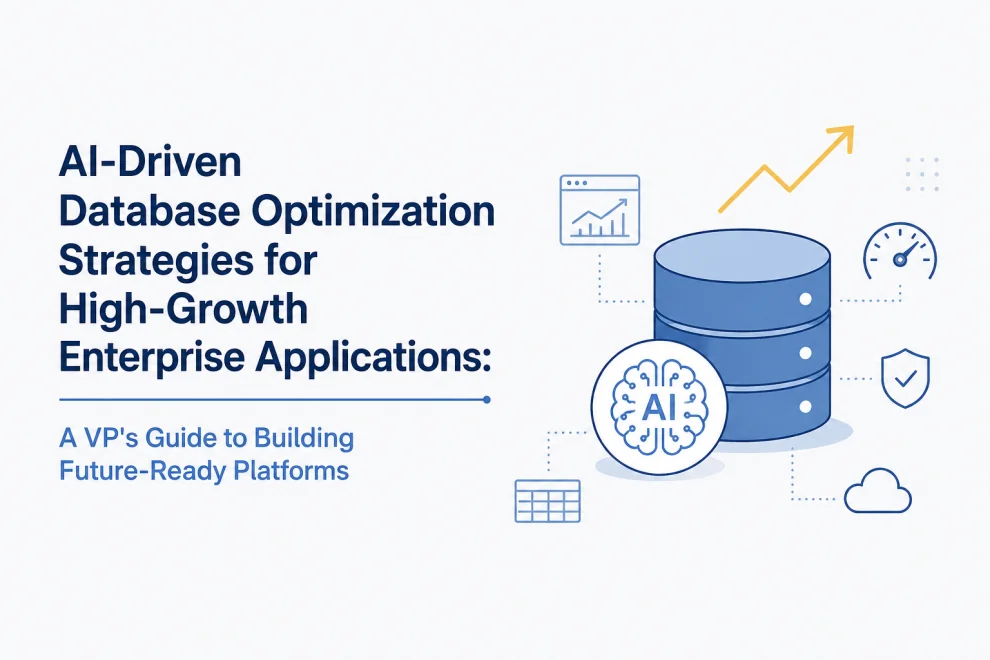

Artificial intelligence is transforming enterprise software at an unprecedented pace. Across North America, organisations are investing heavily in generative AI, intelligent automation, predictive analytics, and AI agents to improve business operations and customer experiences.
Yet many AI initiatives encounter an unexpected obstacle before the model itself becomes the challenge.
The database.
Traditional database optimisation was designed for transactional applications, reporting, and business intelligence. Modern AI applications demand much more. They process enormous volumes of structured and unstructured data, retrieve contextual information in milliseconds, power real time recommendations, and support millions of users simultaneously. Without a modern data foundation, even the most sophisticated AI strategy will struggle to deliver measurable business value.
For leaders responsible for enterprise technology, database optimisation has evolved beyond an infrastructure concern. It is now a strategic capability that influences innovation, operational efficiency, customer experience, and long term business growth.
AI Is Reshaping Enterprise Data Infrastructure
AI applications interact with data very differently from traditional enterprise software.
An AI powered customer support platform may retrieve customer records, search enterprise knowledge bases, analyse previous conversations, generate personalised responses, and update transactional systems within seconds. Every interaction requires multiple database operations across different systems.
The same trend can be seen across industries. Financial institutions process millions of transactions to detect fraud in real time. Manufacturers analyse sensor data from connected equipment. Healthcare providers use AI to assist clinicians with patient information and treatment recommendations.
These workloads require databases that are faster, more intelligent, and capable of scaling without compromising reliability.
Modern enterprise platforms must support low latency performance, hybrid transactional and analytical processing, vector search, global availability, regulatory compliance, and continuous scalability.
Organisations that continue relying on legacy database architectures often experience slower applications, increasing infrastructure costs, and growing operational complexity as AI adoption expands.
The Hidden Cost of Poor Database Performance
Many organisations invest heavily in AI models while overlooking the infrastructure responsible for delivering data to those models.
This creates challenges that directly affect business performance.
Rising Infrastructure Costs
Inefficient queries consume unnecessary compute resources. AI applications magnify these inefficiencies because every inference depends on fast and reliable data retrieval.
Instead of improving utilisation, many organisations simply provision additional cloud resources, increasing operational costs without solving the underlying issue.
Customer Experience Suffers
Customers expect instant digital experiences.
Whether they are interacting with an AI assistant, receiving product recommendations, or completing financial transactions, database latency directly influences satisfaction, engagement, and retention.
Engineering Teams Spend More Time Maintaining Systems
As data volumes increase, engineering teams spend more time troubleshooting database bottlenecks instead of delivering new business capabilities.
This slows innovation and reduces engineering productivity.
AI Performance Becomes Less Reliable
Even the most advanced AI models depend on timely access to accurate information.
If enterprise data cannot be retrieved efficiently, AI systems become slower, less responsive, and less effective.
Five AI Driven Database Optimisation Strategies
Forward thinking organisations are moving beyond traditional indexing and manual query tuning. They are adopting intelligent optimisation techniques that continuously improve performance while reducing operational overhead.
1. Intelligent Query Optimisation
Machine learning algorithms can analyse historical query behaviour and automatically recommend better execution plans before performance declines.
This reduces manual intervention while helping engineering teams maintain consistent application performance as workloads continue to grow.
2. Predictive Resource Scaling
Enterprise workloads have become increasingly unpredictable.
AI powered forecasting models analyse historical traffic, customer behaviour, and application activity to predict future demand. Infrastructure resources can then scale automatically before performance is affected.
This improves application availability while controlling cloud expenditure.
3. AI Assisted Index Management
Enterprise databases often contain thousands of tables supporting multiple business applications.
AI can continuously evaluate indexing strategies, identify redundant indexes, recommend improvements, and optimise storage utilisation without extensive manual effort.
4. Hybrid Database Architectures
Modern AI platforms rarely depend on a single database technology.
Transactional databases, analytical warehouses, vector databases, graph databases, and object storage increasingly work together to support intelligent applications.
A hybrid architecture allows organisations to store different types of data in the most appropriate environment while maintaining governance, security, and operational consistency.
This approach is becoming essential for organisations implementing retrieval augmented generation, recommendation engines, and enterprise search.
5. Continuous Database Observability
Traditional monitoring identifies problems only after they affect users.
AI powered observability detects unusual behaviour, predicts failures, and highlights performance issues before they become business problems.
Engineering leaders gain better visibility into latency, resource utilisation, query performance, and infrastructure costs, enabling faster and more informed decisions.
Database Optimisation Has Become a Business Priority
Database performance should no longer be measured only through technical metrics.
Executive leaders should evaluate how their data infrastructure contributes to strategic business outcomes.
Questions worth asking include:
- Can our current platform support future AI initiatives?
- Are infrastructure costs growing faster than business value?
- How quickly can engineering teams deliver new digital capabilities?
- Does our architecture provide the resilience required for enterprise scale?
- Can we maintain security, governance, and compliance as data volumes continue to increase?
The answers to these questions influence competitive advantage just as much as technology selection.
Building AI Ready Enterprise Platforms
Modernising enterprise databases does not require replacing every existing system.
Successful organisations usually adopt a phased strategy. They identify performance bottlenecks, modernise high impact workloads, introduce intelligent observability, and gradually adopt cloud native database services where they provide measurable value.
Equally important is ensuring that database architecture supports broader digital transformation initiatives.
This includes API first integration, event driven systems, scalable backend services, intelligent automation, and AI ready infrastructure that can evolve alongside changing business requirements.
Why the Right Engineering Partner Matters
Enterprise database transformation is about much more than selecting a new database platform.
Success requires expertise in backend engineering, cloud infrastructure, platform architecture, security, governance, and AI implementation.
Many organisations therefore work with experienced product engineering partners that understand both technology and business outcomes.
For example, GeekyAnts has partnered with enterprises to modernise backend platforms, optimise cloud native architectures, and build AI ready digital products that deliver performance, scalability, and exceptional customer experiences. By combining strong engineering practices with AI expertise, organisations can modernise confidently while preparing their platforms for future innovation.
Frequently Asked Questions
Why is AI changing database optimisation for enterprises?
AI applications process significantly more data than traditional enterprise software. They require fast access to structured, unstructured, and real time data to power features such as AI assistants, predictive analytics, recommendation engines, and intelligent automation. This makes database optimisation a critical part of enterprise AI success.
What are the biggest database challenges enterprises face when adopting AI?
The most common challenges include rising cloud infrastructure costs, slower query performance, data silos, scalability issues, compliance requirements, and managing hybrid workloads that combine transactional, analytical, and AI driven operations.
How does AI improve database performance?
AI can continuously analyse database workloads, optimise query execution, recommend indexing strategies, predict traffic spikes, automate resource allocation, and detect performance anomalies before they affect production systems. This improves both efficiency and reliability.
What is an AI ready database architecture?
An AI ready database architecture is designed to support traditional business applications alongside modern AI workloads. It typically includes cloud native infrastructure, scalable storage, vector search capabilities, real time data processing, strong security, and enterprise grade governance.
Should enterprises replace their existing databases to support AI?
Not necessarily. Most organisations benefit from a phased modernisation strategy that optimises existing systems while gradually introducing cloud native services and specialised databases where they provide measurable business value.
How does database optimisation reduce cloud costs?
Efficient database performance reduces unnecessary compute usage, improves resource utilisation, minimises storage overhead, and prevents organisations from overprovisioning infrastructure. This helps lower operational costs while maintaining application performance.
Which industries benefit the most from AI driven database optimisation?
Industries that process large volumes of business critical data, including financial services, healthcare, retail, manufacturing, logistics, telecommunications, and insurance, often see the greatest benefits from AI driven optimisation.
What should engineering leaders evaluate before modernising their database infrastructure?
Technology leaders should evaluate scalability, performance, security, governance, observability, disaster recovery, cloud portability, integration capabilities, and how well the architecture supports future AI initiatives and digital transformation goals.
How does database optimisation improve customer experience?
Faster databases reduce application latency, improve response times, enable real time personalisation, and ensure AI powered features perform consistently. These improvements contribute to better customer satisfaction, engagement, and retention.
Final Thoughts
Artificial intelligence will continue increasing the demands placed on enterprise data platforms.
The organisations that succeed will not simply build better AI models. They will build stronger data foundations capable of supporting intelligent applications at enterprise scale.
Database optimisation is no longer a back office engineering task. It is a strategic investment that improves customer experience, reduces operational costs, accelerates innovation, and enables sustainable digital transformation.
For technology leaders, investing in AI driven database optimisation today is one of the most practical steps towards building resilient, future ready enterprise platforms.
For more, visit our homepage!





Add Comment