










The Backend Is Becoming an AI Platform
Cloud-native architecture has transformed how enterprises build and deploy applications over the past decade. Containers, Kubernetes, microservices and serverless computing have made software more scalable, resilient and easier to maintain.
Now, another shift is underway.
Artificial intelligence is changing not only the applications businesses build but also the architecture that powers them. Enterprises are no longer designing backend systems solely to process transactions or serve APIs. They are building platforms capable of supporting AI models, intelligent agents, real-time inference and data-intensive workloads.
For technology leaders, this evolution represents more than another infrastructure upgrade. It requires rethinking backend architecture to ensure it can support AI-driven products while maintaining the performance, security and governance expected in enterprise environments.
Why Traditional Backend Architectures Are Falling Short
Many enterprise backend systems were designed around predictable workloads. Requests followed well-defined paths, databases stored structured information and scaling strategies were largely based on traffic volume.
AI applications introduce a different set of demands.
A single user interaction may involve vector database searches, retrieval-augmented generation (RAG), calls to multiple large language models, real-time streaming and orchestration between several services before a response is returned.
These workloads require backend systems that can scale dynamically, process large amounts of unstructured data and maintain low latency even under unpredictable demand.
Cloud-native architecture provides the flexibility needed to meet these requirements, making it an increasingly important foundation for AI-powered applications.
AI Is Changing the Role of the Backend
Traditionally, backend systems managed authentication, business logic, databases and integrations with external services.
Modern AI applications add entirely new responsibilities.
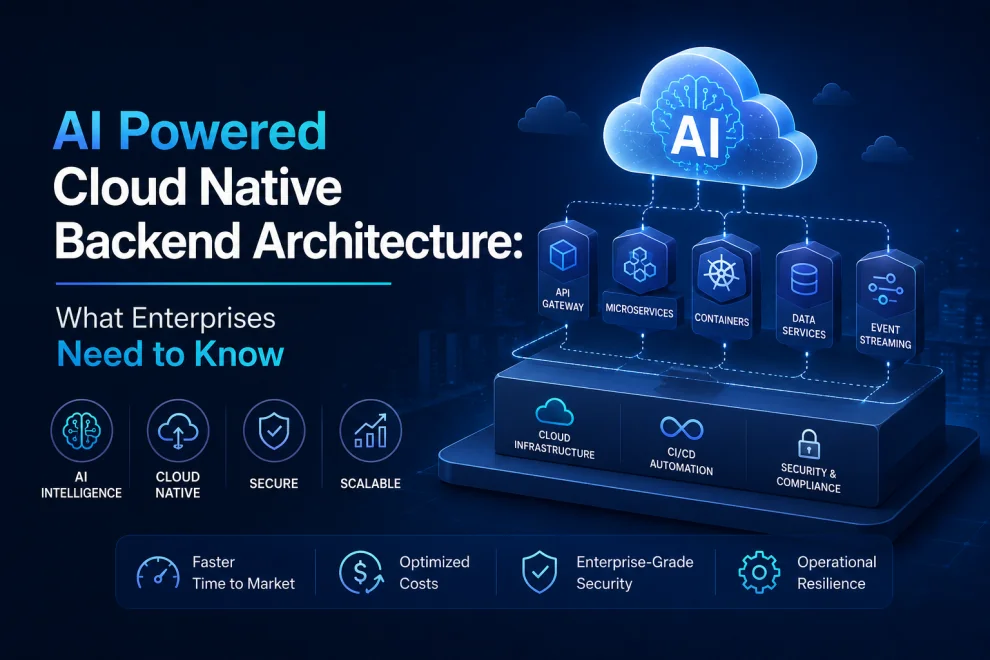
Backend platforms now coordinate AI models, manage prompt orchestration, connect with vector databases, enforce governance policies, cache inference results and monitor model performance. They also determine which model should handle a particular request based on latency, cost or accuracy requirements.
As a result, the backend is becoming an intelligent orchestration layer rather than simply an application server.
This shift is encouraging enterprises to rethink architectural patterns that have remained largely unchanged for years.
Cloud Native Principles Become Even More Important
Cloud-native technologies are particularly well suited for AI workloads because they enable flexibility without sacrificing resilience.
Containerised services allow AI components to scale independently from the rest of the application. Kubernetes enables organisations to allocate compute resources based on demand, while service meshes improve communication between distributed services.
Event-driven architectures also play a growing role by allowing AI systems to respond to real-time events instead of relying on traditional request-response patterns.
These capabilities help enterprises build systems that remain responsive even as AI workloads fluctuate throughout the day.
APIs Are Becoming Intelligence Gateways
Application programming interfaces remain one of the most valuable assets within enterprise architecture.
However, AI is changing what those APIs do.
Instead of simply exposing business data, APIs increasingly orchestrate intelligent services. They connect customer applications with recommendation engines, document processing systems, conversational assistants and predictive analytics platforms.
This evolution means backend engineers must think beyond API performance and consider factors such as model routing, response quality, token usage and governance.
Well-designed APIs are becoming the bridge between traditional enterprise systems and AI-powered experiences.
Security and Governance Cannot Be an Afterthought
AI introduces new architectural considerations that extend beyond infrastructure.
Technology leaders must ensure that backend systems protect sensitive enterprise data while supporting AI services that may operate across multiple environments.
Strong identity management, encrypted communication, secure API gateways and policy-based access controls become even more important when AI models interact with confidential business information.
Governance is equally critical.
Enterprises need visibility into how AI models are being used, which data sources they access and how decisions are generated. Backend platforms increasingly serve as the control point where these governance policies are enforced.
Building AI capabilities without establishing governance often creates operational risks that become difficult to manage as adoption grows.
Observability Is Expanding Beyond Infrastructure
Traditional monitoring focused on CPU usage, memory consumption, network traffic and application availability.
AI-powered applications require much deeper visibility.
Engineering teams now need to monitor inference latency, token consumption, model accuracy, prompt failures and response quality alongside conventional infrastructure metrics.
Modern observability platforms are evolving to provide this broader view, allowing organisations to understand not only whether systems are running but also whether AI services are delivering reliable business outcomes.
This combination of infrastructure monitoring and AI observability is becoming an essential capability for enterprise platforms.
Platform Engineering Is Accelerating AI Adoption
Many enterprises are investing in platform engineering to simplify software delivery across hundreds of development teams.
The same approach is proving valuable for AI initiatives.
Rather than allowing every team to build its own AI infrastructure, platform engineering groups create reusable services, standard deployment patterns and governance frameworks that accelerate development while reducing operational complexity.
This enables developers to integrate AI capabilities without becoming experts in infrastructure management.
Engineering consultancies that work with large enterprises have increasingly highlighted this platform-first approach. Companies such as GeekyAnts have discussed how modern engineering practices, cloud-native development and scalable platform design can help organisations move from experimentation to production-ready digital products more efficiently. The broader industry trend suggests that successful AI adoption depends as much on engineering discipline as it does on model selection.
Preparing Your Backend for an AI-Driven Future
Technology leaders do not need to replace existing backend systems overnight.
Instead, they should evaluate whether current architectures can support evolving AI requirements without introducing unnecessary complexity.
Questions worth considering include whether backend services can scale independently, whether APIs are designed for intelligent workloads, whether governance is embedded into the platform and whether observability extends beyond infrastructure to include AI performance.
Organisations that address these areas today will be better positioned to introduce new AI capabilities as business demands evolve.
The Future Belongs to Intelligent Cloud Native Platforms
Cloud-native architecture has already transformed enterprise software development.
Artificial intelligence is now redefining what those architectures are expected to accomplish.
The backend is evolving from a collection of services into an intelligent platform capable of orchestrating AI models, managing data pipelines, enforcing governance and delivering personalised digital experiences at scale.
For enterprise technology leaders, the opportunity is not simply to adopt AI.
It is to build backend platforms that allow AI to operate securely, reliably and efficiently across the organisation.
Those that invest in cloud-native foundations today will be better prepared for the next generation of enterprise applications, where intelligence is built into every layer of the software stack.
Frequently Asked Questions
What is AI-powered cloud-native backend architecture?
AI-powered cloud-native backend architecture combines cloud-native technologies such as containers, Kubernetes, microservices and APIs with AI capabilities like machine learning models, large language models and intelligent automation to build scalable, resilient and intelligent enterprise applications.
Why are enterprises adopting cloud-native architectures for AI?
Cloud-native platforms provide the scalability, flexibility and resilience needed to handle AI workloads. They allow organisations to deploy AI services independently, optimise resource usage and support real-time inference across distributed systems.
How does AI change backend application development?
AI expands the role of backend systems beyond business logic and APIs. Modern backends manage AI model orchestration, vector databases, prompt processing, inference pipelines, governance and AI observability while maintaining high performance and security.
What technologies are commonly used in AI-powered backend systems?
Enterprise AI backends often use Kubernetes, Docker, microservices, API gateways, event-driven architectures, vector databases, message queues, cloud-native observability platforms and Infrastructure as Code to build scalable AI applications.
What are the biggest challenges when building AI-powered backend applications?
The most common challenges include scaling AI workloads, securing sensitive data, managing infrastructure costs, maintaining low latency, implementing governance, monitoring model performance and integrating AI with existing enterprise systems.
Why is platform engineering important for AI-powered backend architecture?
Platform engineering provides reusable infrastructure, standard deployment patterns and governance frameworks that help development teams build AI-powered applications faster while maintaining consistency, security and operational reliability across the enterprise.
For more, visit our homepage!

Add Comment