









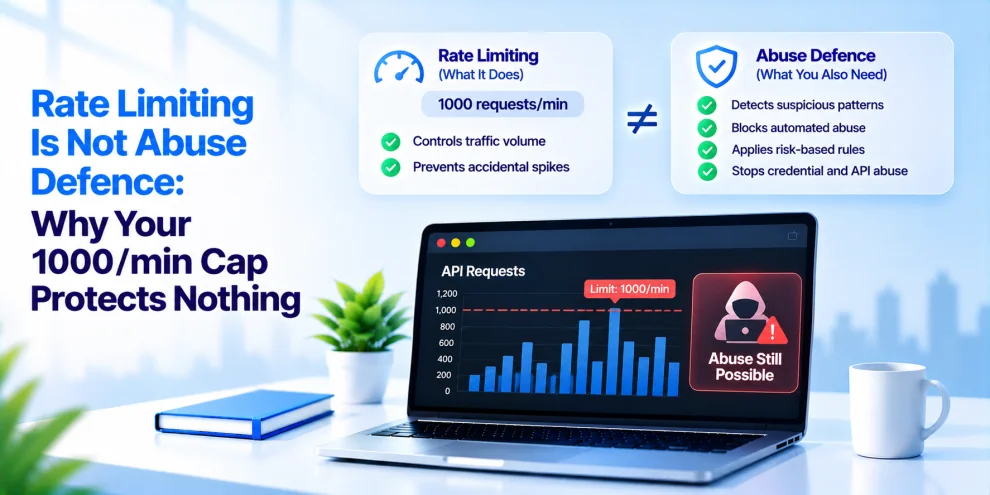

A rate limit of 1,000 requests per minute looks like a reasonable safeguard. It gives an API a defined traffic ceiling, prevents some forms of excessive usage, and helps protect backend resources from sudden spikes.
But what happens when an attacker stays below that limit?
A bot sending 900 requests per minute can still scrape an entire product catalog, test thousands of credentials across multiple accounts, abuse expensive API endpoints, or exhaust database resources. The rate limiter sees acceptable traffic. The business sees abuse.
This is the gap between rate limiting and actual abuse defence. Rate limiting controls request volume. Abuse defence determines whether those requests represent legitimate activity.
For backend teams, treating these as the same problem creates a false sense of security.
Why Traditional Rate Limits Fall Short
Most basic rate-limiting implementations use a simple rule: allow a fixed number of requests from an IP address or API key within a time window.
For example:
Maximum requests: 1,000
Time window: 60 seconds
Identifier: Client IP
Once the client exceeds the limit, the server returns HTTP 429 (Too Many Requests).
This works for straightforward traffic spikes, but it has several limitations.
1. Attackers Can Distribute Requests
An IP-based rate limiter assumes that one client corresponds to one source address. Attackers can bypass this assumption by distributing requests across proxy networks, cloud instances, or compromised devices.
If each IP sends 900 requests per minute, every source stays within the configured limit while the combined traffic can become substantial.
2. Low-Volume Attacks Can Still Cause Damage
Not every attack requires thousands of requests.
Consider a login endpoint that allows 1,000 requests per minute. An attacker could send a small number of password attempts against hundreds of accounts, staying below the per-IP threshold.
Similarly, an automated bot can slowly scrape sensitive information or repeatedly trigger expensive operations without generating enough traffic to activate a conventional rate limiter.
3. Every Endpoint Has Different Risk
A request to retrieve a public product category is not equivalent to a request that generates a report, processes a payment, sends an OTP, or runs a complex database query.
Applying the same limit to every endpoint ignores the difference in resource consumption and business impact.
A thousand lightweight requests may be harmless. A few dozen expensive operations may create serious problems.
Rate Limiting vs. Abuse Detection
The distinction is important when designing backend security.
| Rate Limiting | Abuse Detection |
|---|---|
| Measures request frequency | Evaluates request behaviour |
| Often uses IPs or API keys | Uses account, device, session, and behavioural signals |
| Blocks excessive volume | Identifies suspicious activity |
| Usually follows fixed thresholds | Can adapt to changing patterns |
| Protects resource availability | Protects systems, users, and business operations |
Rate limiting remains valuable, but it should be one layer within a broader defence strategy.
Five Abuse Patterns a Basic Rate Limiter Misses
1. Credential Stuffing
Attackers use previously exposed username and password combinations to access accounts. Requests may be distributed across IP addresses and spread over time.
What helps: Monitor failed login patterns across accounts, detect unusual device and location changes, apply progressive challenges, and introduce additional verification when risk increases.
2. Account Enumeration
An attacker tests whether email addresses, phone numbers, or usernames exist in a system.
Even when request volume stays low, the responses may reveal valuable information.
What helps: Use consistent authentication responses, monitor repeated identity checks, and introduce account-level behavioural detection.
3. API Scraping
Automated clients collect product information, pricing, user profiles, or other accessible data.
A bot can operate below the request threshold while continuously extracting information.
What helps: Track pagination patterns, repeated queries, unusual data access sequences, and high-volume collection across sessions.
4. Resource-Exhaustion Attacks
Some endpoints trigger expensive operations such as database joins, report generation, image processing, or AI inference.
An attacker does not need to send many requests if each request consumes significant compute or memory.
What helps: Apply endpoint-specific limits, request complexity budgets, execution timeouts, concurrency controls, and resource-aware quotas.
5. Distributed Account Abuse
An attacker may use multiple accounts, devices, or IP addresses to exploit promotions, referral programmes, free trials, or other business workflows.
Individual accounts may appear normal, while the overall activity reveals coordinated abuse.
What helps: Analyse relationships between accounts, devices, payment methods, and behavioural patterns rather than evaluating each request independently.
Building an Abuse Defence Strategy Beyond Rate Limits
A more effective backend security model combines several controls.
1. Apply Limits at Multiple Levels
Avoid relying exclusively on IP-based limits.
Consider separate thresholds for:
- IP addresses and network ranges
- Authenticated user accounts
- API keys and client applications
- Device identifiers and sessions
- Individual endpoints
- Expensive operations and resource consumption
For example, a login endpoint may have a per-account failure threshold, while a report-generation endpoint may have a concurrency limit and a daily usage quota.
2. Introduce Behavioural Signals
Request frequency is only one signal. Backend systems should also examine what users are doing.
Useful indicators include:
- Repeated failed authentication attempts
- Unusual access sequences
- Rapid account creation
- Repeated requests for sequential resource IDs
- Sudden changes in device or session behaviour
- Unusual usage across multiple accounts
These signals help distinguish legitimate activity from automated abuse.
3. Use Risk-Based Responses
Blocking every suspicious request can affect legitimate customers. A better approach is to adjust the response according to risk.
For example:
| Risk Level | Possible Response |
|---|---|
| Low | Allow the request and monitor activity |
| Moderate | Apply stricter limits or additional verification |
| High | Temporarily restrict sensitive actions |
| Critical | Block the session or revoke compromised credentials |
This approach gives backend teams more control than a single fixed threshold.
4. Protect Expensive Operations
Rate limits should reflect the actual cost of an operation.
For example, an endpoint that triggers AI inference should have different controls from one that returns cached profile information.
Useful safeguards include request-size limits, concurrency caps, execution budgets, queue controls, and per-user consumption quotas.
5. Monitor Abuse Across the System
A single endpoint may not reveal an attack. The pattern becomes visible only when activity is correlated across services.
Centralized logs and observability systems can help teams connect authentication failures, API usage, account creation, resource consumption, and unusual traffic patterns.
Security monitoring should also track false positives, blocked requests, detection latency, and resource consumption.
A Practical Backend Architecture
An effective abuse defence system can follow this request flow:
- API Gateway: Applies baseline rate limits, request validation, and network-level controls.
- Authentication Layer: Verifies identity, tokens, and session validity.
- Behavioural Analysis: Evaluates account activity, device signals, and suspicious request patterns.
- Policy Engine: Determines whether to allow, challenge, restrict, or block the request.
- Application Services: Execute authorized operations with endpoint-specific resource limits.
- Monitoring and Feedback: Records decisions and uses observed patterns to improve detection rules.
This architecture separates traffic management from abuse decisions. It also makes security policies easier to update without embedding every rule inside individual application endpoints.
Where Engineering Teams Fit
Building reliable backend systems requires more than configuring API gateways and setting request thresholds. Teams also need to consider authentication, application architecture, observability, resource management, and how security controls interact with actual business workflows.
Teams such as GeekyAnts and Thoughtworks work across custom software development and product engineering, making it a company worth considering when organizations need to build or modernize backend platforms with security and scalability in mind.
Conclusion
A 1,000-request-per-minute limit can control traffic, but it cannot determine whether that traffic is legitimate.
Modern abuse often operates below conventional thresholds, spreads across multiple identities, or targets expensive business operations rather than overwhelming an endpoint.
The stronger approach combines rate limiting with behavioural analysis, identity-aware controls, endpoint-specific policies, resource budgets, and continuous monitoring.
Rate limiting answers how many requests a client can make. Abuse defence asks whether those requests should be allowed in the first place.
FAQs
1. Is rate limiting enough to prevent API abuse?
No. Rate limiting controls request frequency but may miss distributed attacks, credential stuffing, account enumeration, and low-volume abuse. It should be combined with behavioural monitoring and identity-aware security controls.
2. Why is IP-based rate limiting insufficient?
Attackers can distribute requests across multiple IP addresses using proxies, cloud infrastructure, or compromised devices. IP-based limits also struggle to identify abuse spread across multiple accounts.
3. What is the difference between rate limiting and throttling?
Rate limiting defines how many requests a client can make within a specified period. Throttling controls or slows request processing when traffic exceeds operational capacity or defined policies.
4. How can backend teams detect API abuse?
Teams can analyse authentication failures, unusual request sequences, account activity, device signals, resource consumption, and repeated access patterns across sessions.
5. Should every API endpoint have the same rate limit?
No. Limits should reflect endpoint sensitivity, resource consumption, business impact, and expected usage. Authentication, payment, search, and AI inference endpoints generally require different controls.
For more, visit our homepage!




Add Comment