



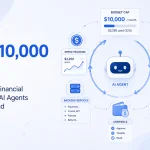



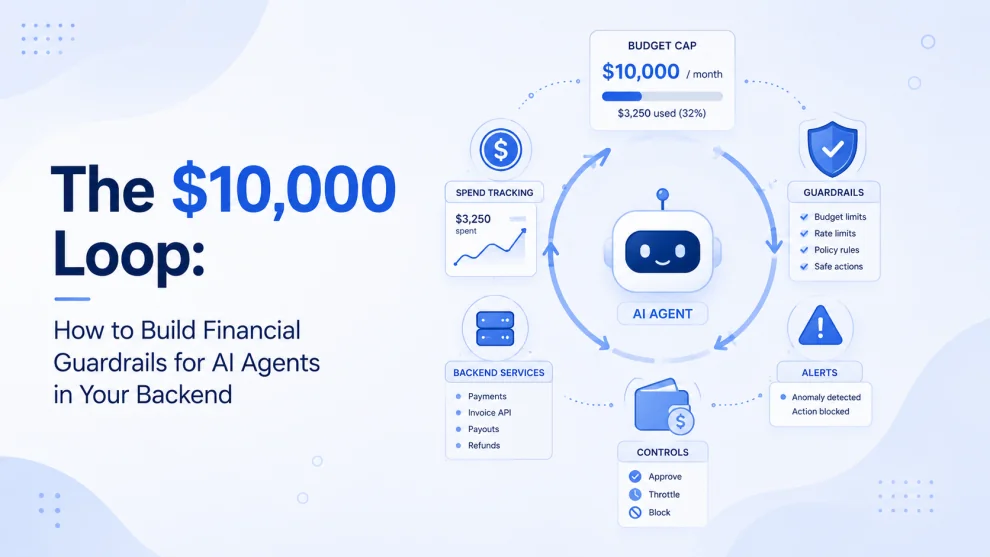

AI agents are moving beyond answering questions. They can now call APIs, create transactions, interact with payment systems, manage subscriptions, trigger workflows, and make decisions across backend services. That capability creates a new engineering challenge: what happens when an autonomous agent makes the same expensive action repeatedly? A single incorrect tool call may be recoverable, but a loop that repeatedly triggers a paid API, creates transactions, issues refunds, or provisions infrastructure can turn a small logic failure into a significant financial incident. The hypothetical “$10,000 loop” represents this class of failure: an AI agent repeatedly performing an economically costly action without recognizing that something has gone wrong. For large organizations, financial safety cannot depend on a system prompt telling an agent to “be careful.” Cost and transaction controls need to exist outside the model, inside the backend architecture. The model can recommend an action, but deterministic backend systems should decide whether that action is permitted.
Why AI Agents Create a New Financial Risk
Traditional applications generally follow predefined execution paths. Developers determine when a payment is initiated, how many times an API can be called, and which conditions must be satisfied before a transaction is completed. AI agents introduce more dynamic behavior. An agent may decide which tool to call, determine the sequence of operations, interpret an API response, retry an action, and continue working toward a goal. This flexibility is useful, but it creates additional failure modes. An agent may misunderstand an instruction, repeatedly retry a failed operation, misinterpret a successful response, call an expensive service unnecessarily, or become trapped in a reasoning loop. If every action has a financial consequence, the backend needs mechanisms that can stop the agent before the cost becomes material.
Never Let the Agent Control the Spending Limit
The first architectural rule is simple: the agent should never be the final authority over its own spending. An LLM can estimate that an operation should cost $50, but it should not be trusted to determine whether it is allowed to spend $50. Financial limits should be enforced by deterministic backend services. These services can evaluate the authenticated user, agent identity, operation type, current spend, transaction value, frequency, and environment before allowing an action. This creates a separation between reasoning and authorization. The agent decides what it wants to do. The backend decides whether it is allowed to do it.
Create an Agent Budget Layer
A dedicated budget layer can track financial exposure across agent operations. Instead of allowing every tool call to execute independently, the backend can associate each agent session with defined limits. A budget might include a maximum amount per transaction, maximum cumulative spend per session, maximum number of paid operations, maximum spend per user, and maximum spend over a defined time period. For example, an internal research agent might have a small API usage allowance, while an automated procurement workflow may have a larger approved transaction limit. The important part is that these limits are enforced outside the model.
Use Multiple Spending Boundaries
One limit is rarely enough. A robust architecture can combine per-action limits, per-session limits, per-user limits, per-agent limits, organizational limits, and global emergency limits. Suppose an agent is permitted to make a $100 transaction. That does not mean it should be allowed to make 100 such transactions within a few seconds. A cumulative session limit can stop repeated execution. A rate limit can stop rapid retries. An organizational limit can prevent multiple agents from collectively exceeding an approved threshold. These controls work together to contain financial exposure.
Add a Transaction Risk Score
Not every agent action carries the same level of financial risk. A read-only analytics query may have minimal financial impact, while issuing a refund or initiating a payment can have significant consequences. The backend can assign risk levels to operations based on factors such as transaction value, destination, frequency, user identity, historical behavior, and operation type. Low-risk actions may execute automatically. Medium-risk operations may require additional validation. High-risk transactions may require human approval or secondary authentication. This creates a graduated control system rather than treating every agent action identically.
Introduce Hard Stop Conditions
Agents need deterministic termination conditions. If an agent exceeds its transaction limit, repeats the same tool call too many times, encounters repeated failures, or reaches a predefined execution budget, the backend should terminate the workflow. The system should not wait for the model to recognize that it is stuck. For example, if an agent calls the same payment API repeatedly with the same parameters, the backend can detect the repeated pattern and block additional attempts. A hard stop is particularly important because AI systems can continue generating plausible reasoning even when the underlying workflow is no longer progressing.
Idempotency Is a Financial Control
Idempotency is critical when AI agents interact with payment and transaction APIs. If an agent retries a request because it believes the previous operation failed, the backend should be able to determine whether that transaction has already been processed. Unique idempotency keys can prevent duplicate charges, duplicate orders, duplicate refunds, or repeated financial operations. This is a standard backend reliability principle, but autonomous agents make it even more important because the decision to retry may come from probabilistic reasoning rather than deterministic application logic.
Separate Intent From Execution
A useful architecture separates an agent’s proposed action from the actual transaction. The agent can produce an intent such as “issue a $250 refund for order 8472.” The backend then validates the request against authorization rules, transaction limits, account state, fraud policies, and spending controls before executing it. This prevents the model from directly controlling a payment API. The same principle applies to other costly operations such as purchasing third-party API capacity, provisioning infrastructure, initiating advertising spend, or executing resource-intensive workloads.
Require Approval for High-Value Actions
Not every transaction should be fully autonomous. High-value or irreversible operations can require human approval before execution. The threshold should depend on the organization’s risk profile and the specific workflow. For example, an agent may automatically process routine low-value transactions but escalate unusually large transactions to an authorized employee. This approach preserves automation for high-volume workflows while introducing additional control for exceptional cases.
Monitor Cost in Real Time
Financial guardrails are ineffective if the organization discovers excessive spending after the fact. Backend systems should expose real-time telemetry around agent activity. Useful metrics include spend per agent, spend per user, transaction volume, tool-call frequency, failed operations, retries, average transaction value, and cumulative session cost. Engineering teams should also monitor sudden deviations from normal behavior. An agent that normally performs ten paid API calls per session but suddenly performs thousands should trigger an automated response.
Detect Loops Instead of Only Tracking Cost
Cost monitoring tells you that something is wrong. Loop detection can help stop it earlier. The backend can monitor repeated sequences of tool calls, identical requests, repeated failures, rapid retries, and cycles between multiple tools. For example, an agent could alternate between a search API and a processing API indefinitely. Each individual operation may appear legitimate, but the repeated sequence may indicate that the agent is stuck. Execution graphs and trace data can help identify these patterns.
Use OpenTelemetry for Agent Cost Observability
AI agent workflows can span multiple services, making it difficult to understand where financial exposure originates. Distributed tracing can connect a user request to the agent session, model invocation, tool calls, backend APIs, and downstream services. With OpenTelemetry-based instrumentation, engineering teams can associate operational telemetry with agent activity and identify which workflows generate the highest volume or cost. For organizations already using observability platforms, adding agent-specific attributes such as agent ID, workflow ID, tool name, transaction ID, authorization decision, and cost category can make financial monitoring significantly more actionable.
Protect Against Prompt-Driven Spending
An attacker may intentionally manipulate an agent into performing expensive actions. A malicious prompt could attempt to persuade an agent to repeatedly call a paid service, create unnecessary transactions, or bypass normal approval logic. This is why prompt-level instructions are insufficient. The backend should assume that the model can produce an unsafe request and enforce spending, authorization, and rate limits independently. Prompt injection and financial abuse should therefore be treated as application security problems rather than purely AI behavior problems.
Isolate Agent Credentials
Agent identities should have narrowly scoped permissions. An agent responsible for customer support should not automatically have payment execution privileges. An analytics agent should not be able to create transactions. A procurement agent may need purchasing capabilities, but those capabilities should be restricted to approved vendors, categories, and limits. Separate identities make it easier to determine which agent performed an operation and to revoke permissions without affecting unrelated workflows.
Create a Financial Circuit Breaker
A circuit breaker can provide an emergency mechanism for stopping agent activity when financial behavior becomes abnormal. The breaker can activate when spending exceeds a defined threshold, transaction frequency increases unexpectedly, repeated failures occur, or an unusual pattern is detected. Once triggered, additional transactions can be blocked until an authorized team reviews the situation. This is particularly valuable for large-scale environments where multiple agents may be operating simultaneously.
Design for Partial Failure
AI workflows often depend on multiple systems. A payment service may respond slowly. An external API may return an ambiguous response. A database transaction may succeed while the agent fails to receive the response. These conditions can cause unnecessary retries. Backend systems should distinguish between confirmed failure and unknown transaction state. Before retrying a financial operation, the system should verify whether the original request was processed. This is another reason why transaction status APIs and idempotency mechanisms are essential.
Keep the Agent’s Toolset Small
More tools mean more potential failure paths. Instead of giving an agent access to dozens of general-purpose APIs, expose narrowly defined capabilities relevant to the workflow. A tool such as issue_refund(order_id, amount) is easier to secure than giving an agent unrestricted access to a payment database. Narrow tools allow backend teams to attach explicit authorization, validation, limits, and audit requirements to each operation.
Build an Audit Trail
Every financially relevant agent action should be traceable. The audit record should identify the user, agent, workflow, tool, transaction, authorization decision, timestamp, requested amount, approved amount, and execution result. For sensitive environments, the audit trail should also capture the policy or rule that permitted or blocked the action. This creates accountability and makes post-incident investigation substantially easier.
Test Agents With Adversarial Scenarios
Financial guardrails should be tested before production deployment. Engineering teams should intentionally simulate scenarios such as repeated transactions, failed payment responses, duplicate requests, manipulated prompts, excessive tool calls, compromised dependencies, unusual transaction amounts, and concurrent agent sessions. The goal is to verify that the backend remains safe even when the model behaves unexpectedly. Testing should also include failure scenarios where external services return incomplete, delayed, contradictory, or misleading responses.
What Engineering Leaders Should Audit
Technology and engineering leaders should ask whether every agent action has an independent authorization layer, whether transaction limits are enforced outside the model, whether agents have narrowly scoped identities, whether expensive operations have rate limits, whether financial actions are idempotent, whether high-value operations require approval, and whether real-time monitoring can detect abnormal spending. They should also ask a more fundamental question: If an AI agent goes into an infinite loop tonight, what is the maximum amount it can cost before the system stops it? If the answer is unclear, the architecture does not yet have sufficient financial guardrails.
Where Engineering Partners Add Value
Building financially safe AI agents requires more than connecting an LLM to a payment API. It requires backend architecture, identity management, authorization, observability, transaction design, API controls, and operational safeguards to work together. Engineering teams such as GeekyAnts can help organizations design AI-enabled backend systems where autonomous workflows operate within clearly defined technical and financial boundaries. The important principle is to keep financial authority in deterministic backend controls while allowing AI to provide reasoning and automation within those boundaries.
The Future of Financial Guardrails for AI Agents
As AI agents become capable of executing increasingly complex workflows, financial controls will become a core part of agent architecture. Organizations will need to think beyond traditional authentication and API authorization and introduce concepts such as agent budgets, transaction risk scoring, execution limits, circuit breakers, behavioral monitoring, and autonomous workflow controls. The goal is not to eliminate autonomy. It is to make autonomy bounded. An agent should be able to move quickly, call tools, make decisions, and complete workflows, but every financially meaningful action should pass through deterministic controls that the model cannot override. The “$10,000 loop” is ultimately a reminder of a broader engineering principle: never allow probabilistic software to have unlimited access to deterministic financial consequences. AI can decide what it wants to do. Your backend should decide what it is allowed to do.
For more, visit our homepage!


Add Comment