



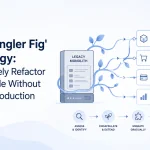



Legacy systems rarely disappear in a single modernization project. In large organizations, critical applications often contain years of accumulated logic, integrations, dependencies, and operational knowledge. Replacing everything at once may look attractive on an architecture diagram, but the risk of disrupting production can make a full rewrite impractical. The Strangler Fig pattern offers a more controlled alternative: gradually replace parts of a legacy system with modern services while keeping the existing application operational. With AI now capable of analyzing codebases, mapping dependencies, generating tests, and assisting with refactoring, the pattern is becoming even more practical. But AI should accelerate modernization, not become an uncontrolled mechanism for rewriting production systems.
What Is the Strangler Fig Pattern?
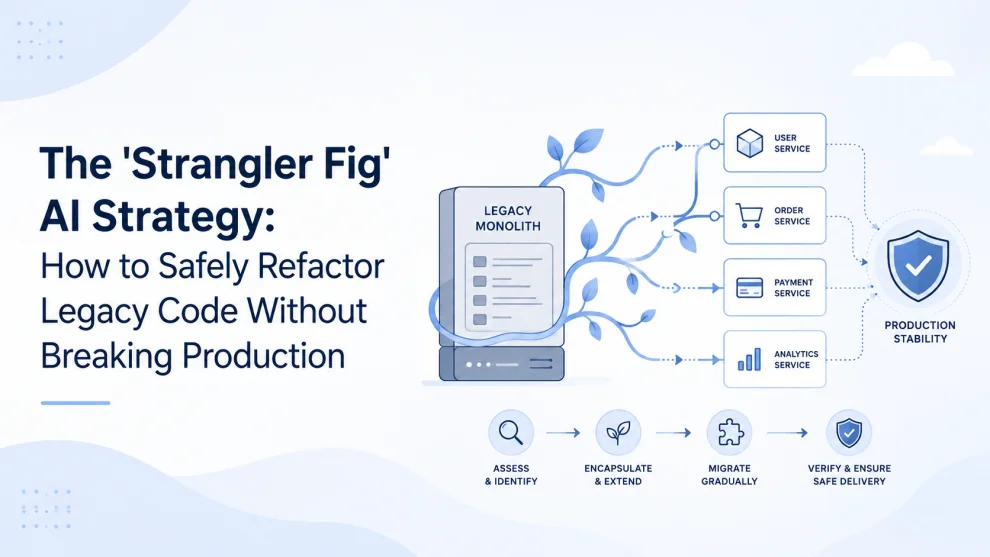
The Strangler Fig pattern is a modernization approach in which new functionality is progressively built around an existing application until the legacy system becomes smaller and less important. Instead of replacing the entire platform, engineering teams identify specific capabilities and move them into modern components one at a time.
The name comes from the strangler fig tree, which grows around an existing structure and gradually replaces it. In software architecture, the concept is similar. A legacy application continues serving production traffic while modern services progressively take responsibility for selected functions.
This approach is particularly useful for organizations with large applications where downtime, migration failures, or a complete rewrite could have significant operational consequences.
Why AI Changes the Modernization Equation
Traditional legacy modernization often begins with manual code discovery. Engineers need to understand what the existing application does, which services depend on it, where data flows, and which parts are safe to change. In large codebases, this analysis can take months.
AI-assisted engineering can reduce some of this effort. Modern AI tools can help developers summarize unfamiliar modules, identify repeated patterns, explain complex functions, generate documentation, map relationships between components, and suggest potential refactoring opportunities.
AI can also assist with creating tests around legacy behavior. This is particularly valuable because undocumented behavior is one of the biggest risks in legacy modernization. Before replacing a component, teams need confidence that the existing system’s important behavior has been captured.
However, AI-generated explanations and code should be treated as engineering inputs rather than authoritative truth. Legacy systems often contain edge cases that may not be obvious from source code alone.
Start With Discovery, Not Rewriting
The biggest mistake in AI-assisted modernization is starting with code generation before understanding the system.
Engineering teams should first create a technical map of the legacy environment. This includes major application components, databases, external integrations, authentication mechanisms, scheduled processes, message queues, critical workflows, and production dependencies.
AI can help accelerate this discovery by analyzing source repositories and generating initial documentation. Static analysis, runtime telemetry, logs, and dependency information should then be used to validate those findings.
The goal is to build a reliable picture of how the application actually behaves, not just how developers believe it behaves.
Identify the Right Components to Extract
Not every legacy component should be modernized first.
A good candidate is usually a capability with clear boundaries, measurable functionality, manageable dependencies, and meaningful value from modernization. A tightly coupled module that interacts with dozens of undocumented components may be a poor starting point.
Teams should evaluate candidate components based on factors such as dependency complexity, production criticality, data ownership, change frequency, testing coverage, and migration risk.
Starting with a relatively contained capability allows the organization to establish its migration process before attempting more complex transformations.
Create a Safety Net Before Refactoring
Before replacing legacy behavior, teams need confidence that production behavior can be measured.
Automated tests are important, but they are not the only source of confidence. Production telemetry, API behavior, transaction outcomes, performance metrics, error rates, and business-critical workflows can provide additional evidence.
AI can help generate unit and integration tests from existing code, but generated tests should be reviewed carefully. A test that simply confirms the current implementation may preserve a defect rather than capture the intended behavior.
The objective is to establish behavioral contracts that describe what the system is expected to do.
Introduce a Controlled Routing Layer
Once a new implementation is ready, traffic can gradually move toward it through a routing layer, API gateway, proxy, or service boundary.
Initially, most requests may continue reaching the legacy implementation. A small percentage can be directed to the new service.
This provides a controlled migration path. If the new implementation performs poorly, traffic can be routed back to the legacy system without reversing the entire modernization effort.
For large production environments, this ability to shift traffic incrementally is one of the most important safety mechanisms in the Strangler Fig approach.
Use AI for Refactoring, Not Blind Rewriting
AI coding systems can generate significant amounts of code quickly, but modernization should not become a copy-and-paste exercise.
A legacy application may contain implicit assumptions about data formats, transaction boundaries, concurrency, error handling, authentication, and external integrations. A generated replacement can compile successfully while behaving differently under real production conditions.
AI is most useful when developers provide constrained tasks such as converting a well-understood module, generating tests, improving documentation, identifying duplicated logic, or proposing a safer implementation.
The engineer remains responsible for deciding whether the generated solution is correct.
Preserve Contracts During Migration
One of the safest ways to modernize a legacy component is to preserve its externally visible contract initially.
If an existing API has consumers across multiple applications, changing the API and replacing the underlying implementation simultaneously creates unnecessary risk.
A modern service can initially implement the existing interface while internally improving the architecture. Once the new implementation is stable, teams can gradually introduce better interfaces or new capabilities.
This separates modernization from unnecessary consumer migration.
Protect Data Boundaries
Data migration is often more difficult than code migration.
Legacy applications may share databases across multiple functions, contain duplicated records, rely on undocumented relationships, or use database-level logic that is not obvious from the application layer.
Before extracting a service, teams should determine who owns the relevant data and how other components interact with it.
A safer approach may initially involve a compatibility layer or carefully controlled access to existing data rather than immediately moving everything into a new database.
Data ownership can then be separated gradually as the architecture matures.
Use Shadow Traffic Carefully
Shadow traffic can provide valuable evidence before switching production requests to a new implementation.
In a shadowing model, production requests are copied to the new service while the legacy system remains responsible for the actual response. The outputs can then be compared to identify behavioral differences.
This can reveal edge cases that conventional testing missed.
However, shadow traffic must be designed carefully. The shadow system should not accidentally perform write operations, trigger external actions, send notifications, or modify production data.
Read-only execution and controlled test environments are important when validating new implementations against production-like workloads.
Compare More Than Functional Output
A successful migration is not simply one where the new service returns the same response.
Engineering teams should compare latency, error rates, resource consumption, throughput, database behavior, dependency failures, and operational characteristics.
A modernized component that produces correct responses but increases latency or infrastructure consumption may still create a production problem.
Observability should therefore be part of the migration architecture from the beginning.
Gradually Increase Traffic
Once the new component has demonstrated stable behavior, traffic can move gradually.
A migration might begin with internal users or a small percentage of requests, followed by larger traffic segments as confidence increases.
Each stage should have clearly defined success criteria and rollback conditions.
This is where the Strangler Fig approach differs significantly from a traditional rewrite. The organization does not need to make one irreversible decision. It can continuously evaluate the new component and expand its responsibility as evidence improves.
Make Rollback a First-Class Capability
Every migration step should have a documented rollback path.
If error rates increase after a traffic shift, the organization should be able to route traffic back to the legacy implementation quickly.
Rollback should not depend on manually rebuilding systems during an incident. Routing configuration, deployment automation, feature flags, versioned artifacts, and infrastructure automation should make reversal predictable.
The safest modernization strategy is one where failure is recoverable.
Avoid Creating a Distributed Monolith
The Strangler Fig pattern can fail if teams extract services without establishing meaningful boundaries.
Simply moving pieces of a monolithic application into separate services does not automatically create a better architecture. If every new service remains tightly dependent on the same database and communicates through complex chains of synchronous calls, the organization may end up with a distributed monolith.
Teams should therefore extract capabilities around clear ownership and responsibilities rather than simply splitting code by technical layers.
Manage Technical Debt During the Transition
Modernization creates an unusual period where legacy and modern architectures coexist.
This can temporarily increase complexity. Teams may need compatibility APIs, synchronization mechanisms, duplicated monitoring, and additional deployment processes.
That complexity should be treated as temporary migration infrastructure.
Every migration should have a clear definition of what will eventually be removed. Otherwise, the organization can accumulate a permanent layer of compatibility code that becomes another source of technical debt.
Establish AI Governance
AI-assisted modernization introduces another dimension of governance.
Generated code should pass through the organization’s normal security, testing, review, and compliance processes. Teams should also consider how proprietary source code and sensitive information are handled by AI development tools.
For highly regulated or sensitive environments, engineering leaders should establish clear policies around approved AI tools, code handling, data exposure, generated dependencies, testing requirements, and human review.
The objective is not to prevent AI-assisted development. It is to make AI usage compatible with existing engineering controls.
Measure Modernization With Production Outcomes
Modernization programs should not be measured only by the amount of legacy code removed.
More meaningful indicators include deployment frequency, change failure rate, service reliability, application latency, incident frequency, developer productivity, infrastructure efficiency, and the time required to introduce new capabilities.
A component that is technically modern but operationally unreliable is not a successful modernization.
The purpose of the Strangler Fig strategy is to improve the system while maintaining production confidence.
What Engineering Leaders Should Ask
VPs of Engineering, technology leaders, and platform teams should ask several questions before beginning an AI-assisted modernization program: Which legacy components create the greatest operational constraint? Which capabilities have clear boundaries? What production behavior must remain unchanged? Where are the undocumented dependencies? Can traffic be shifted safely? Can the new implementation be rolled back quickly? Who owns the underlying data? How will AI-generated code be reviewed? Which security controls must remain unchanged? How will success be measured after migration?
These questions help move modernization from an abstract architecture initiative toward a controlled engineering program.
Where AI and Engineering Partners Fit
AI can significantly accelerate the analysis and implementation phases of legacy modernization, but organizations still need experienced engineers to validate architectural decisions, manage production risk, and coordinate changes across systems. Engineering teams such as GeekyAnts can support modernization initiatives by combining AI-assisted development with backend engineering, application architecture, DevOps, testing, and production-focused delivery practices.
The strongest approach is not to ask AI to rewrite an entire legacy platform. It is to use AI where it provides leverage while maintaining engineering ownership over architecture, security, testing, and production decisions.
The Future of Legacy Modernization
Legacy modernization will increasingly become an incremental process rather than a single rewrite project. AI can make large codebases easier to understand, accelerate repetitive refactoring work, generate test coverage, and help teams identify opportunities for architectural improvement. But the safest modernization programs will combine those capabilities with controlled traffic migration, strong observability, explicit data boundaries, automated rollback, and human review.
The Strangler Fig strategy provides a practical foundation for this model. Instead of asking whether an organization can replace its legacy system, engineering leaders can ask a more useful question: Which part can we safely replace next?
That shift changes modernization from a high-risk transformation into a sequence of measurable engineering decisions. When each step is observable, reversible, and governed, organizations can modernize critical applications without making production the testing ground for a complete rewrite.
For more, visit our homepage!

Add Comment