









Enterprise technology teams are under increasing pressure to deliver digital products faster without compromising scalability, reliability, or customer experience. Over the last few years, many large organizations have modernized cloud infrastructure, adopted microservices, and accelerated digital transformation initiatives. Yet one challenge continues to slow execution across engineering teams: API complexity.
For organizations operating across web platforms, mobile applications, customer portals, partner ecosystems, internal dashboards, and AI-driven services, traditional REST architectures are becoming harder to scale efficiently. Engineering leaders are seeing longer development cycles, duplicated backend logic, inconsistent data handling, and growing infrastructure costs tied directly to API inefficiencies.
This is one of the reasons GraphQL has moved from an emerging developer trend into a strategic enterprise technology decision.
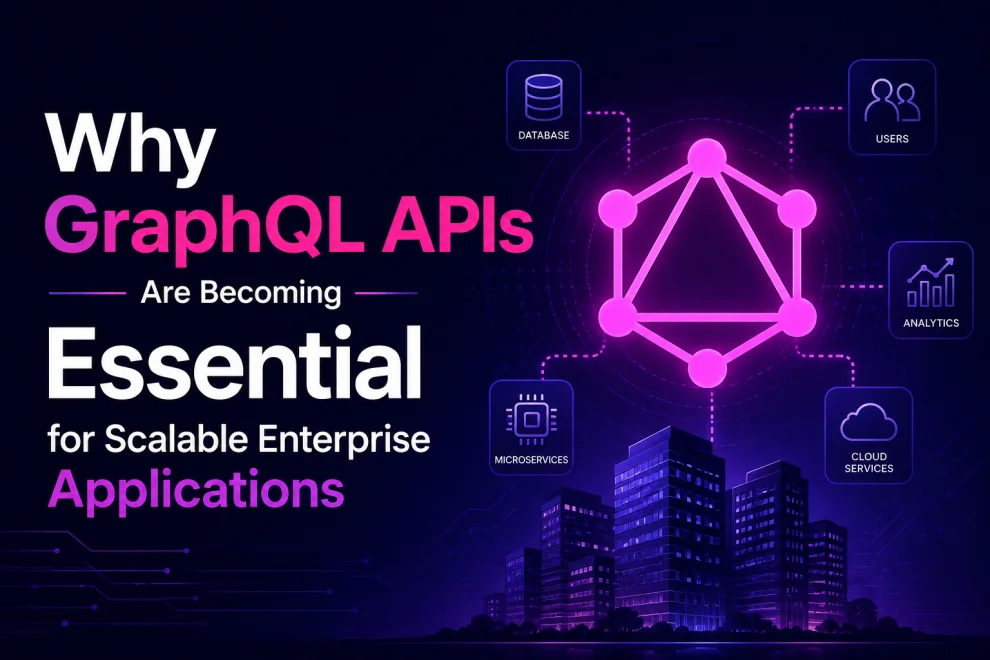
Originally developed by Meta, GraphQL allows applications to request only the data they need through a single API layer. While that sounds technical on the surface, the business implications are significant for enterprises managing complex digital ecosystems.
Large organizations are increasingly using GraphQL to simplify backend orchestration, reduce frontend dependency bottlenecks, and improve platform scalability across distributed engineering teams. Companies such as Netflix, Shopify, and GitHub have publicly discussed the operational advantages of GraphQL in large-scale environments.
For North American enterprises managing multiple customer-facing platforms, GraphQL is becoming less about experimentation and more about operational efficiency.
Why Traditional REST Architectures Start Slowing Enterprise Teams
Most enterprise engineering environments did not fail because of poor technology decisions. They became difficult to scale because business growth created layers of APIs, integrations, services, and frontend requirements faster than backend architectures could evolve.
A typical enterprise platform today may support:
- Mobile applications
- Web portals
- Internal admin systems
- Partner APIs
- IoT platforms
- AI and analytics services
- Regional customer experiences
In REST-heavy environments, each frontend application often requires separate endpoints, repeated backend aggregation logic, and version management overhead. As systems scale, engineering teams spend more time maintaining APIs than improving customer experiences.
This creates several operational issues:
- Frontend teams wait on backend changes for even minor data requirements.
- APIs return excessive data, increasing bandwidth and cloud consumption costs.
- Engineering teams duplicate business logic across services to support multiple applications.
- Platform modernization slows because legacy APIs remain tightly coupled to frontend architectures.
For leadership teams focused on digital transformation metrics, these issues directly affect release velocity, engineering productivity, and customer experience consistency.
GraphQL addresses many of these bottlenecks by introducing a more flexible API query model. Instead of exposing multiple rigid endpoints, GraphQL provides a unified schema where applications request only the required data.
This matters significantly for enterprises operating large frontend ecosystems. Mobile teams, web teams, and product teams can move independently without requiring constant backend restructuring.
According to the 2025 State of GraphQL report by Apollo GraphQL, organizations adopting GraphQL reported improvements in developer productivity, API discoverability, and cross-team collaboration. Enterprise adoption has grown particularly in industries where customer experience and multi-platform consistency directly affect revenue generation.
Why Engineering Leaders Are Prioritizing GraphQL in Platform Strategies
For enterprise decision-makers, GraphQL adoption is not primarily about replacing REST. Most organizations continue operating hybrid API environments. The real value comes from improving scalability and reducing operational friction inside distributed systems.
Modern enterprises increasingly operate with platform engineering models where internal developer experience matters as much as external customer experience. Backend flexibility now influences how quickly organizations can launch new products, integrate acquisitions, support AI initiatives, or expand digital services globally.
GraphQL supports these goals in several ways.
First, it improves frontend autonomy. Product and frontend teams can iterate faster because they control data queries without requiring backend teams to continuously create new endpoints.
Second, GraphQL simplifies API orchestration across microservices environments. Instead of frontend applications calling multiple APIs independently, GraphQL consolidates data retrieval through a centralized schema layer.
Third, GraphQL aligns well with composable architecture strategies. Many enterprises are moving toward modular platforms where services evolve independently. GraphQL provides a cleaner abstraction layer between frontend experiences and backend systems.
This is particularly relevant as enterprises integrate AI-powered experiences into customer-facing products. AI services often require dynamic access to structured datasets across multiple systems. Flexible query architectures become increasingly valuable in these environments.
Companies like GeekyAnts, Thoughtworks, and EPAM Systems are actively working on API modernization and platform engineering initiatives that increasingly incorporate GraphQL into scalable enterprise ecosystems.
The shift reflects a broader market reality. Enterprises no longer compete only on product functionality. They compete on release speed, digital responsiveness, personalization capabilities, and platform adaptability.
GraphQL Is Becoming Important for Multi-Platform Digital Experiences
Customer expectations continue rising across industries. Users expect consistent digital experiences whether they engage through mobile apps, web platforms, connected devices, or customer support channels.
Traditional API models struggle to support this efficiently at scale.
A retail enterprise, for example, may require:
- Different product data for mobile versus desktop
- Personalized pricing engines
- Real-time inventory updates
- AI recommendation systems
- Regionalized storefront experiences
REST APIs often create fragmented integration patterns across these systems. GraphQL introduces a more unified and adaptable approach that better supports experience-driven architectures.
This becomes increasingly important as enterprises adopt:
- Headless commerce
- Super apps
- Omnichannel platforms
- AI copilots
- Real-time analytics dashboards
- Edge-delivered digital experiences
GraphQL also supports stronger developer onboarding and internal API discoverability. Large enterprises frequently struggle with fragmented documentation and inconsistent service ownership across teams. Unified schemas improve governance without heavily restricting innovation.
However, implementation strategy matters.
Engineering leaders evaluating GraphQL adoption should assess:
- Existing API architecture maturity
- Schema governance models
- Security and access control requirements
- Performance optimization strategy
- Internal developer enablement
GraphQL is not automatically simpler than REST. Poor schema design can create operational complexity if governance is weak. Successful enterprise adoption usually involves gradual integration rather than full replacement strategies.
Organizations seeing the strongest outcomes often begin with customer-facing aggregation layers or frontend-heavy applications before expanding GraphQL deeper into platform infrastructure.
The Enterprise API Conversation Is Shifting
Over the next several years, API architecture decisions will increasingly influence enterprise agility. Organizations modernizing digital platforms are prioritizing architectures that reduce operational dependency chains while improving scalability across engineering teams.
GraphQL fits naturally into that direction because it supports flexibility without forcing enterprises to completely rebuild backend systems.
For leadership teams responsible for platform modernization, customer experience delivery, and engineering efficiency, the conversation is no longer whether GraphQL is technically viable. The focus is shifting toward how quickly organizations can operationalize modern API strategies without disrupting existing systems.
That is why many enterprises are exploring implementation models with engineering partners experienced in platform scalability, API orchestration, and modern frontend-backend integration patterns.
Teams evaluating modernization opportunities are increasingly studying how companies such as GeekyAnts and other enterprise engineering consultancies are approaching GraphQL adoption within larger digital transformation initiatives.
In many cases, the goal is not to follow a trend. The goal is to remove friction that slows delivery, increases operational costs, and limits platform adaptability in competitive markets.
For enterprises scaling across multiple digital channels, GraphQL is becoming an important part of that solution.




Add Comment