






Enterprise AI adoption is moving beyond experimentation. Many North American enterprises now operate multiple AI initiatives simultaneously across customer support, internal productivity, analytics, developer tooling, and digital product experiences. The challenge is no longer whether teams should integrate AI. The challenge is controlling how AI systems behave once they become embedded into enterprise workflows.
This shift is pushing engineering leaders toward a new architectural layer: AI middleware.
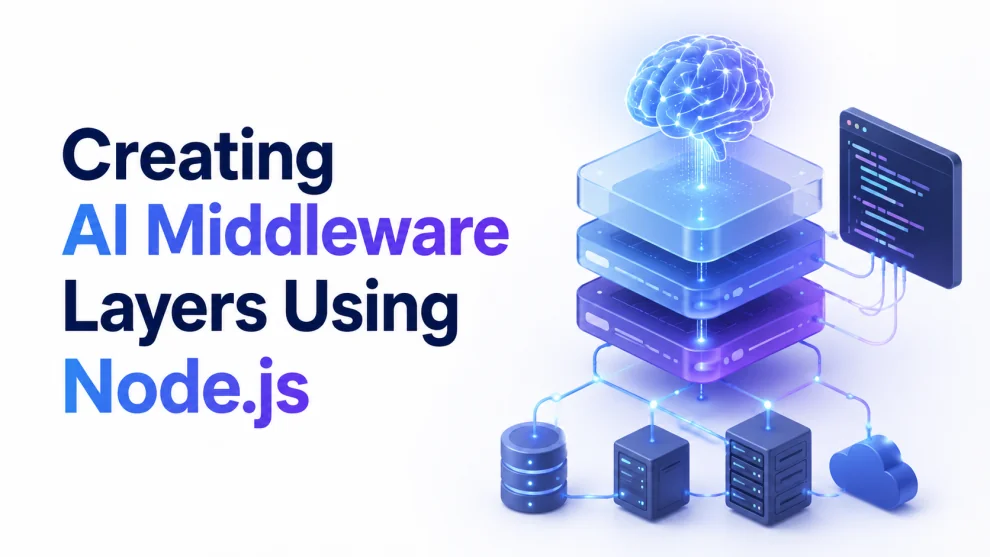
Instead of connecting applications directly to large language models, enterprises are increasingly building centralized middleware layers that manage orchestration, governance, observability, security, and model interoperability. Node.js is becoming one of the preferred technologies for this layer because it aligns well with modern API ecosystems, event-driven architectures, and distributed enterprise platforms.
For engineering leadership teams managing large digital ecosystems, the conversation has moved away from “Which AI model should the company use?” and toward “How does the company prevent fragmented AI infrastructure from becoming operational debt?”
That question is now shaping platform engineering decisions across industries including fintech, healthcare, retail, logistics, and SaaS.
Why Direct AI Integrations Are Creating Operational Problems
Many enterprises entered AI adoption through isolated experiments. Product teams connected applications directly to APIs from providers like OpenAI, Anthropic, or Google. Internal teams built proof-of-concept copilots. Customer service groups introduced AI chat interfaces independently. Over time, these disconnected implementations created architectural inconsistencies.
The result is familiar to most enterprise technology leaders:
- Multiple AI vendors operating across separate business units
- No centralized governance for prompts or outputs
- Escalating inference costs
- Security concerns around sensitive enterprise data
- No consistent observability layer
- Limited control over latency and failover
- Difficulty swapping models without application rewrites
According to Gartner, organizations are increasingly prioritizing AI governance frameworks because scaling AI without centralized operational control creates significant compliance and operational risks. Enterprises operating at multi-billion-dollar scale cannot rely on fragmented integrations managed by individual teams.
This is where AI middleware architecture becomes strategically important.
An AI middleware layer acts as a centralized orchestration and control system between enterprise applications and AI services. Instead of every application independently interacting with models, the middleware layer standardizes how requests, prompts, policies, and outputs are handled.
Node.js is gaining traction in this space because enterprise teams already use it extensively for API gateways, backend orchestration, microservices, and real-time systems. It allows engineering teams to introduce AI orchestration without introducing entirely new infrastructure paradigms.
Why Node.js Fits AI Middleware Architectures
Node.js was not originally designed for AI systems. However, its asynchronous architecture and API-centric ecosystem make it highly effective for AI middleware workloads.
AI middleware often needs to perform several tasks simultaneously:
- Route requests across different AI providers
- Manage streaming responses
- Enforce authentication and access policies
- Monitor token usage and costs
- Integrate vector databases and retrieval systems
- Handle retries and fallback logic
- Coordinate multi-model orchestration
These workflows align naturally with Node.js event-driven execution patterns.
Large enterprises also prefer technologies that reduce operational friction across engineering teams. Many frontend, backend, and platform engineering groups already work within JavaScript or TypeScript ecosystems. Using Node.js for middleware reduces onboarding complexity and accelerates cross-functional collaboration.
Another important factor is ecosystem maturity. Frameworks such as NestJS, Fastify, and Express continue to dominate enterprise API development. AI orchestration libraries including LangChain.js and LlamaIndex are also expanding rapidly within Node.js environments.
This is allowing engineering organizations to build AI middleware stacks without completely restructuring existing cloud infrastructure.
Companies like GeekyAnts, Thoughtworks, and EPAM Systems are increasingly discussing AI platform engineering models that prioritize orchestration layers instead of isolated AI feature development.
The architectural trend is becoming clearer: enterprises want abstraction layers that future-proof AI investments.
What AI Middleware Actually Handles Inside the Enterprise
For leadership teams evaluating AI platform modernization, the term “middleware” can sometimes sound abstract. In practice, AI middleware layers solve highly operational business problems.
One of the most important capabilities is model abstraction. Enterprises do not want applications tightly coupled to a single model provider. Middleware layers allow teams to switch between models depending on latency, pricing, compliance, or workload type.
For example, a customer support workflow might use one model for summarization, another for classification, and a third for retrieval-augmented generation. The application itself should not need to manage those decisions directly.
Middleware also centralizes governance.
As AI regulations continue evolving across North America and Europe, enterprises are introducing stricter controls around prompt logging, data retention, PII filtering, and auditability. AI middleware creates a centralized enforcement layer instead of relying on every application team to implement compliance independently.
Observability is another growing priority.
Most enterprises already operate mature monitoring systems for APIs, infrastructure, and distributed services. AI systems introduce additional operational variables including hallucination tracking, token consumption, inference latency, and prompt performance. Middleware layers allow platform teams to standardize telemetry across all AI interactions.
This becomes especially important at scale.
A global enterprise processing millions of AI requests monthly cannot afford uncontrolled usage patterns or unpredictable vendor billing structures. Middleware introduces rate limiting, caching, routing intelligence, and cost visibility.
Engineering leaders are increasingly treating AI traffic the same way they treat cloud infrastructure traffic: measurable, governed, and optimized.
The Shift Toward Enterprise AI Platform Engineering
The rise of AI middleware is also changing organizational structures inside enterprise technology teams.
Previously, AI initiatives often sat within innovation labs or isolated data science groups. Today, many organizations are integrating AI directly into platform engineering roadmaps. This changes ownership models significantly.
Platform teams now influence:
- AI infrastructure governance
- Enterprise-wide orchestration standards
- Vendor interoperability strategies
- AI reliability engineering
- Cost optimization frameworks
This shift mirrors earlier cloud-native transformations. Organizations that initially treated cloud adoption as isolated experimentation eventually moved toward centralized platform engineering models. AI is following a similar path.
Node.js middleware layers fit naturally into this transition because they support incremental modernization rather than complete system replacement.
Instead of rebuilding entire enterprise stacks, organizations can introduce AI middleware as an orchestration layer across existing APIs, microservices, and customer platforms.
This approach reduces migration risk while enabling faster AI rollout across multiple business units.
It also gives leadership teams more flexibility during a rapidly changing AI vendor landscape. New models, providers, and tooling ecosystems are evolving too quickly for enterprises to hardcode dependencies into customer-facing applications.
Middleware creates insulation against that volatility.
What Technology Leaders Should Prioritize Next
Many enterprises still underestimate the operational complexity of scaling AI beyond pilot stages. The technical challenge is no longer generating AI outputs. The real challenge is building systems that remain observable, governable, and adaptable over time.
For technology executives, several priorities are becoming increasingly important:
- Standardizing AI access through centralized APIs
- Building vendor-agnostic orchestration layers
- Introducing governance before scaling adoption
- Creating reusable AI infrastructure components
- Aligning platform engineering with AI operations
Organizations that delay middleware strategies often encounter integration sprawl within 12 to 18 months of AI expansion.
This is why enterprise architecture discussions are increasingly focusing on AI infrastructure maturity rather than individual AI applications.
Engineering consultancies and platform specialists are responding accordingly. Firms such as GeekyAnts, Thoughtworks, and EPAM Systems are actively contributing to conversations around scalable AI platform architectures, orchestration frameworks, and enterprise integration models.
For leadership teams evaluating long-term AI scalability, the most valuable discussions are no longer centered on isolated chatbot deployments. They are centered on infrastructure resilience, operational governance, and architectural flexibility.
That is where AI middleware is becoming a competitive differentiator.
And for enterprises already operating complex digital ecosystems, Node.js is positioning itself as one of the most practical technologies for building that layer efficiently.




Add Comment