









API ecosystems have become the operational backbone of enterprise platforms. Banking systems, retail applications, healthcare portals, logistics networks, SaaS products, and internal enterprise tools now depend on APIs to exchange data continuously across cloud environments, devices, and third party services.
That growth has created a major operational challenge for engineering leadership teams. Traditional authentication systems were designed for predictable user behavior, static infrastructure, and smaller digital ecosystems. Modern enterprises no longer operate under those conditions.
Today, enterprise APIs handle millions of requests across distributed architectures, AI powered applications, edge devices, partner ecosystems, and machine to machine interactions. Security teams are now expected to secure this environment without slowing down customer experience, developer productivity, or platform scalability.
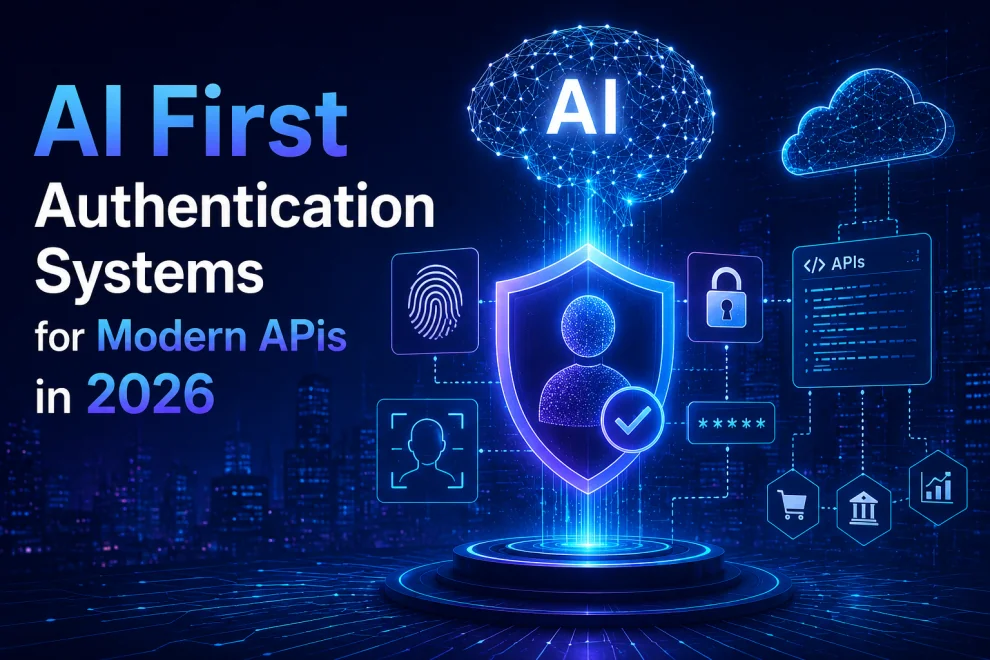
This is where AI first authentication systems are gaining traction across North American enterprises.
Rather than relying only on static credentials, predefined rules, or manual policy enforcement, AI first authentication models continuously evaluate context, behavioral patterns, traffic anomalies, and risk signals in real time. The goal is not simply stronger authentication. The goal is adaptive trust management across increasingly complex digital platforms.
The shift is happening quickly because enterprise leaders are under pressure from both sides. Cybersecurity threats continue to increase, while customers expect faster and more seamless digital experiences.
According to IBM’s Cost of a Data Breach Report, the global average cost of a data breach reached $4.88 million in 2024, the highest recorded to date. Identity compromise and credential related attacks remain among the most common entry points for attackers. At the same time, organizations face rising pressure to reduce login friction, improve API response times, and support omnichannel digital products.
For platform engineering and digital transformation leaders, this creates a difficult balancing act. Security measures that disrupt customer workflows often impact revenue, retention, and operational efficiency. Weak authentication models increase exposure to account takeover, API abuse, and compliance risk.
AI first authentication is emerging as a practical response to that problem.
Why Traditional API Authentication Models Are Reaching Their Limits
Most enterprise authentication architectures still depend heavily on static controls. Passwords, API keys, token validation, OAuth flows, and role based access control remain foundational components of identity systems. These approaches still matter, but they struggle to adapt dynamically to evolving threat behavior.
Attackers now use automation, AI generated phishing campaigns, credential stuffing, session hijacking, and bot driven attacks at a scale that manual rule based systems cannot easily manage.
The challenge becomes more severe in large enterprises operating across hybrid cloud environments. Teams often manage fragmented identity providers, legacy systems, multiple customer applications, and inconsistent access policies across regions and business units.
This creates several operational issues:
- Security teams spend significant time responding to false positives and manual access reviews.
- Engineering teams face deployment delays when authentication systems become tightly coupled with legacy infrastructure.
- Customer experience teams struggle with authentication friction that impacts onboarding, conversion, and retention.
AI first authentication systems address these challenges differently. Instead of treating authentication as a one time checkpoint, they treat identity validation as a continuous process.
These systems analyze variables such as device posture, user behavior, access patterns, geolocation shifts, typing dynamics, network activity, and API consumption behavior in real time. If risk signals change during a session, authentication requirements can dynamically adapt without requiring full user interruption.
This approach aligns well with zero trust architecture strategies that many North American enterprises are already adopting.
Gartner has projected that organizations embracing continuous adaptive trust models will significantly reduce identity related breach exposure over the next several years. That prediction is driving increased investment in intelligent identity infrastructure across industries including finance, healthcare, logistics, manufacturing, and enterprise SaaS.
Importantly, AI first authentication is not replacing existing identity standards like OAuth 2.0, OpenID Connect, or SAML. Instead, it adds intelligence layers that improve risk evaluation and automated decision making around those systems.
For engineering leaders, this distinction matters because modernization does not always require a complete infrastructure rebuild.
AI Driven Authentication Is Becoming a Platform Engineering Priority
The growing importance of platform engineering teams is also accelerating this trend.
Modern engineering organizations increasingly operate shared internal platforms that support multiple product teams, APIs, and customer experiences simultaneously. Authentication systems can no longer exist as isolated security functions. They now directly impact release velocity, developer experience, observability, and platform resilience.
An AI first approach helps enterprises centralize authentication intelligence while maintaining flexibility across products and services.
Several large organizations are already moving in this direction by integrating machine learning driven anomaly detection into API gateways, identity access management systems, and cloud security operations. Providers such as Microsoft, Okta, Cloudflare, and Google Cloud continue expanding AI assisted identity protection capabilities across enterprise environments.
At the same time, consulting and engineering partners including GeekyAnts are seeing increased enterprise demand for authentication modernization projects tied to API platform scalability, cloud migration, and customer experience transformation initiatives.
The conversation is no longer only about security compliance. It is increasingly about operational resilience and digital growth.
For example, customer facing applications now need authentication systems that can distinguish between legitimate automation and malicious traffic without blocking valid API usage. Internal enterprise applications require adaptive access policies for remote workforces operating across multiple devices and regions. Developer platforms need authentication frameworks that simplify integrations while maintaining governance controls.
AI driven authentication systems help organizations move toward these goals because they can automate risk evaluation at a scale that human security teams cannot consistently achieve alone.
However, implementation still requires careful planning.
What Enterprise Leaders Should Evaluate Before Modernizing Authentication Systems
Many organizations underestimate how deeply authentication systems affect platform architecture. Authentication touches infrastructure, application performance, compliance operations, customer experience, DevOps pipelines, and third party integrations simultaneously.
As a result, rushed modernization efforts often create new operational bottlenecks.
Enterprise leaders evaluating AI first authentication strategies typically focus on four key areas:
- Integration compatibility with existing API gateways, cloud environments, and identity providers
- Real time scalability for high volume API ecosystems
- Governance and auditability requirements for regulated industries
- Customer experience impact across mobile, web, and machine driven interactions
The most successful implementations usually begin with limited high impact use cases rather than enterprise wide replacement initiatives. Many organizations first deploy AI assisted authentication around high risk APIs, privileged access workflows, or customer identity systems where fraud exposure and operational complexity are highest.
This phased approach reduces disruption while helping engineering and security teams evaluate measurable outcomes.
Another important factor is observability.
AI driven authentication systems generate large volumes of behavioral and risk analysis data. Without strong observability frameworks, organizations may struggle to interpret automated decisions or investigate incidents effectively. Engineering leaders increasingly prioritize authentication systems that integrate cleanly with existing monitoring, SIEM, and cloud operations workflows.
This is particularly important as regulators increase scrutiny around AI governance, identity verification, and automated decision making.
For many large enterprises, the broader strategic question is no longer whether AI will influence authentication systems. The real question is how quickly existing identity architectures can evolve without disrupting platform delivery goals.
That transition will likely define the next phase of enterprise API modernization.
Organizations that successfully align authentication intelligence with platform scalability, developer productivity, and customer experience objectives will be better positioned to support increasingly connected digital ecosystems.
As enterprise engineering teams continue evaluating this shift, many are turning to architecture consultations, API modernization assessments, and platform security reviews to identify where adaptive authentication can create measurable operational value without adding unnecessary complexity.
Explore more enterprise technology insights and platform engineering strategies on our homepage .




Add Comment