










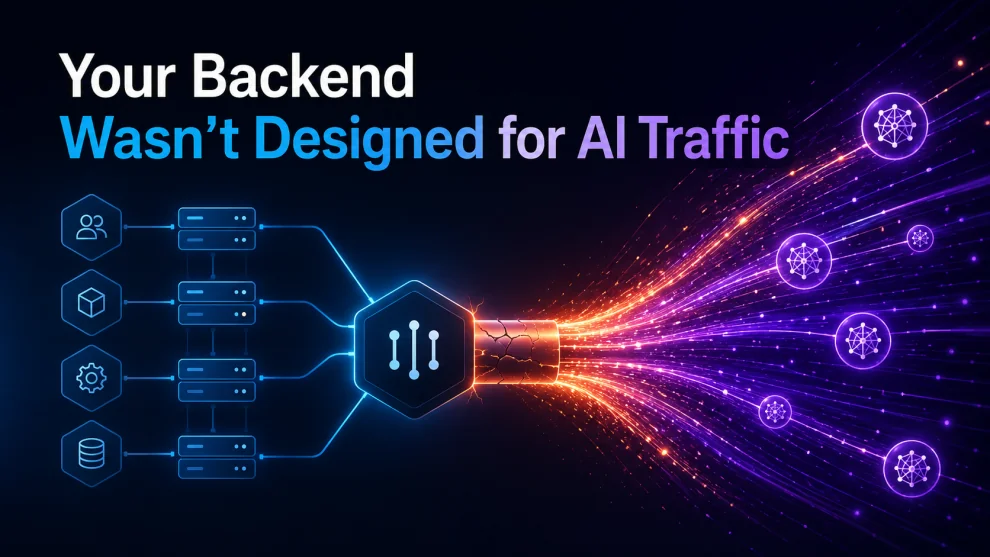

Enterprise infrastructure teams spent the last decade preparing for digital scale.
They modernized applications, migrated workloads to the cloud, adopted Kubernetes, expanded APIs, introduced microservices, and invested heavily in DevOps automation.
Then AI traffic arrived.
And many backend systems immediately started behaving in ways they were never designed to handle.
Across large enterprises in the United States — organizations with 5,000 to 100,000+ employees and revenues ranging from $500 million to multi-billion-dollar operations — engineering leaders are discovering that AI workloads create a completely different category of infrastructure pressure.
Traditional web traffic is relatively predictable. AI-driven traffic is not.
Generative AI systems produce longer-running requests, higher concurrency spikes, larger payloads, unpredictable compute bursts, and significantly more backend orchestration complexity. Instead of handling lightweight transactional interactions, enterprise systems now process continuous inference calls, vector database lookups, streaming responses, multi-model routing, and AI-assisted workflows simultaneously.
For many enterprises, the issue is not simply scaling infrastructure.
The issue is that their backend architecture assumptions no longer match production reality.
According to Gartner, more than 80% of enterprises are expected to use generative AI APIs or deploy AI-enabled applications by 2026. At the same time, IDC projects global AI infrastructure spending will continue growing rapidly as organizations shift from experimentation to operational deployment.
That transition is exposing backend limitations across industries.
Engineering leaders are now dealing with a new operational challenge: AI demand is growing faster than backend modernization efforts.
AI Traffic Behaves Differently From Traditional Application Traffic
Most enterprise backend systems were optimized for transactional efficiency.
A user logs in. A request hits an API gateway. A database query executes. A response returns within milliseconds.
AI workloads disrupt that model completely.
A single AI-assisted workflow may trigger:
- multiple API calls
- vector search operations
- GPU inference requests
- streaming outputs
- retrieval pipelines
- orchestration services
- third-party model integrations
- caching layers
- observability pipelines
This dramatically increases backend coordination overhead.
The challenge becomes even more difficult inside enterprises operating hybrid environments with legacy systems, cloud-native services, regional compliance layers, and distributed application teams.
Many backend architectures were never designed for sustained inference-heavy workloads.
As AI adoption expands internally, operational bottlenecks begin surfacing quickly:
- API latency spikes
- queue congestion
- inconsistent autoscaling behavior
- rising infrastructure costs
- degraded customer experiences
- observability blind spots
- overloaded data pipelines
For VP-level engineering leaders, the problem is no longer theoretical.
Customer-facing systems are already feeling the pressure.
A retail recommendation engine failing during peak demand directly affects conversion rates. An AI-assisted support workflow introducing latency increases customer frustration. Internal productivity systems slowing down during inference bursts reduce operational efficiency across teams.
This is why backend modernization conversations are rapidly shifting from “cloud migration” to “AI infrastructure readiness.”
The Real Problem Is Backend Coordination Complexity
Many enterprises initially assumed AI adoption would primarily increase compute demand.
Instead, the larger challenge has become orchestration complexity.
AI systems rarely operate in isolation. They depend on interconnected services across data pipelines, security layers, APIs, analytics platforms, and customer applications.
That dependency chain creates cascading operational risks.
For example, a customer-facing AI assistant may depend on:
- Retrieval systems connected to enterprise data stores
- Multiple external model providers
- Authentication and governance systems
- Real-time analytics pipelines
- Frontend streaming infrastructure
- Logging and compliance frameworks
A failure or slowdown anywhere inside that chain can affect the entire user experience.
This is why many engineering leaders are discovering that scaling AI infrastructure is not simply about adding GPUs.
It requires redesigning backend workflows themselves.
The organizations adapting fastest are investing heavily in:
- event-driven architectures
- asynchronous processing layers
- distributed caching strategies
- AI-aware observability systems
- workload prioritization models
- intelligent autoscaling frameworks
According to industry reports from Deloitte and McKinsey, enterprises operationalizing AI successfully are increasingly treating infrastructure modernization as a business-critical transformation initiative rather than an isolated innovation project.
That distinction matters.
Because AI traffic does not remain inside experimentation environments for long.
Once AI features start affecting customer journeys, revenue operations, internal productivity, or digital products, backend reliability immediately becomes an executive concern.
Traditional Scalability Models Are Becoming Expensive
Another challenge emerging in 2026 is infrastructure cost volatility.
Many enterprises are discovering that AI traffic creates unpredictable spending patterns across cloud environments.
Inference-heavy applications can generate sudden compute spikes, large memory demands, and elevated networking costs. Teams relying only on traditional autoscaling approaches often struggle to maintain predictable operational efficiency.
This becomes especially difficult for organizations already operating large distributed systems.
A platform handling millions of customer interactions daily cannot simply overprovision infrastructure indefinitely.
Engineering leaders are therefore shifting focus toward backend efficiency rather than raw scalability.
That means optimizing:
- request routing
- workload distribution
- model orchestration
- data retrieval pipelines
- caching efficiency
- API prioritization
- infrastructure observability
The objective is no longer just keeping systems online.
The objective is maintaining AI responsiveness without creating unsustainable infrastructure costs.
This operational pressure is changing how enterprises evaluate backend engineering talent and modernization strategies.
Organizations increasingly want engineering teams capable of connecting cloud infrastructure, AI orchestration, frontend systems, and platform scalability into a unified delivery model.
That shift explains why platform engineering and backend modernization are becoming closely connected inside enterprise transformation programs.
Backend Engineering Is Becoming an AI Operations Function
The next phase of enterprise AI adoption will likely depend less on model experimentation and more on infrastructure execution.
Many organizations already proved they can deploy AI features.
The harder challenge is sustaining them at production scale.
This is where backend engineering teams are taking on a much larger operational role.
Modern backend systems must now support:
- real-time inference workloads
- AI orchestration pipelines
- streaming architectures
- distributed observability
- hybrid cloud coordination
- governance enforcement
- workload resiliency
In effect, backend engineering is evolving into an AI operations discipline.
For Heads of Engineering and Digital Transformation leaders, this changes investment priorities significantly.
The focus is moving away from isolated AI pilots toward scalable backend ecosystems capable of supporting continuous AI-driven traffic growth.
That transition is also influencing how enterprises approach modernization partnerships.
Organizations increasingly prefer engineering partners that understand platform scalability, frontend integration, AI-ready architectures, cloud infrastructure, and product engineering together rather than as disconnected services.
Companies are becoming more visible in these discussions because enterprises are looking for teams capable of aligning scalable digital product engineering with backend modernization and platform evolution. As AI adoption expands across customer-facing applications and internal systems, execution capability is becoming just as important as infrastructure strategy.
For enterprise technology leaders, the warning signs are becoming difficult to ignore.
Most backend systems currently powering large organizations were not originally designed for sustained AI-driven traffic patterns.
And as AI workloads continue moving from experimentation into production-scale operations, the enterprises that redesign backend coordination, scalability, and infrastructure efficiency early may avoid the operational bottlenecks many organizations are only beginning to experience now.



Add Comment