





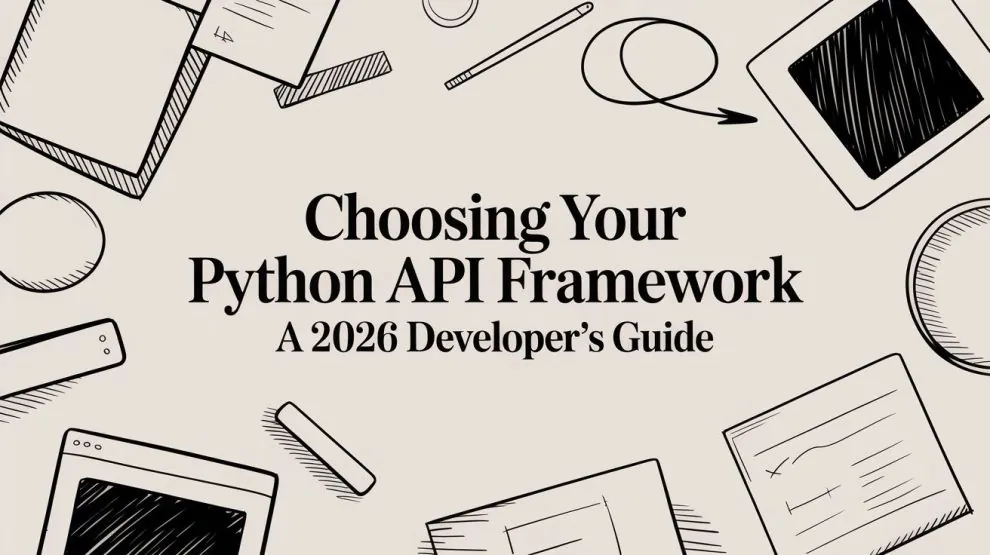

Picking the right Python API framework in 2026 really boils down to one question: Are you building something that needs the comprehensive, out-of-the-box power of a full-stack system, or do you need the lean, blazing-fast performance of a specialized microframework? This decision between the established giants and the modern speed demons will fundamentally shape how you build, scale, and maintain your project.
Why Your Python API Framework Choice Matters

Choosing a framework is more than just a technical detail; it’s one of the earliest and most impactful architectural decisions you can make. It sets the tone for developer productivity, defines how your application will behave under pressure, and even influences how easy it is to hire engineers. This guide digs into the core philosophies behind today’s top contenders.
We're going to explore the critical trade-offs between two main camps:
- Established Frameworks: Think Django REST Framework (DRF). These tools give you a structured, "batteries-included" ecosystem that's perfect for complex applications where getting to market quickly is the top priority.
- Modern Microframeworks: Here, names like FastAPI and Falcon lead the pack. They are built for raw speed and minimalism, making them a natural fit for high-throughput microservices and API-centric architecture.
Getting this choice right is crucial. If you want a broader view of the ecosystem, our guide on the best backend frameworks provides excellent context. Here, we'll give you the practical insights needed to confidently select the right tool for your next project.
Django REST Framework vs. FastAPI: The Core Tradeoff

When you're picking a Python API framework, the conversation almost always lands on Django REST Framework (DRF) versus FastAPI. These two aren't just tools; they represent fundamentally different philosophies for building APIs.
DRF is the seasoned veteran. It builds directly on Django's "batteries-included" foundation, giving you an entire ecosystem out of the box. With its powerful ORM, built-in authentication, and a browsable API for easy testing, DRF is designed for rapid development of complex, data-centric applications. It's structured, opinionated, and incredibly productive.
FastAPI, on the other hand, is the modern challenger built for pure speed and flexibility. It's asynchronous from the ground up, making it a natural fit for high-concurrency applications and microservices. Its killer features are automatic data validation using Pydantic and interactive API documentation (thanks to OpenAPI), which developers absolutely love.
This choice is a major architectural decision, especially in a market projected to grow from $18.21 billion to an astounding $177.78 billion by 2032, as detailed in market analysis from sources like Inveritasoft.
The central trade-off is clear: DRF provides a structured, all-in-one toolkit for rapid development, while FastAPI delivers exceptional speed and modern features for API-first architectures.
To really see the differences side-by-side, this table breaks down their core characteristics.
DRF vs FastAPI At a Glance
| Feature | Django REST Framework (DRF) | FastAPI |
|---|---|---|
| Philosophy | "Batteries-included," part of a full-stack ecosystem. | Minimalist, "bring your own tools," focused purely on the API. |
| Performance | Synchronous (WSGI), solid but not built for peak speed. | Asynchronous (ASGI), exceptionally fast and high-performing. |
| Data Validation | Handled by Serializers, which can be verbose. | Automatic via Pydantic models using Python type hints. |
| API Documentation | Requires third-party packages to generate. | Automatic, interactive documentation (Swagger UI & ReDoc). |
| Authentication | Robust, built-in system (sessions, tokens, OAuth). | Flexible; requires implementing your own security schemes. |
| Database/ORM | Tightly integrated with the powerful Django ORM. | No built-in ORM; you choose your own (e.g., SQLAlchemy, Tortoise ORM). |
| Community/Maturity | Very mature, massive community, extensive documentation. | Modern, rapidly growing, excellent official documentation. |
| Best For | Full-stack web apps, monolithic systems, CRUD-heavy APIs. | Microservices, high-traffic APIs, real-time applications. |
Ultimately, neither is universally "better"—they just excel in different scenarios. Your team's existing knowledge, project requirements, and performance needs will be the deciding factors.
If you're new to the core concepts, you can get up to speed with our guide on how to build a REST API.
A Look at the Microframeworks: Flask, Falcon, and Sanic
Sometimes, a full-stack framework is just too much. For projects that demand speed, minimalism, and total control, microframeworks are where the real action is. Flask has long been the default choice for anyone wanting a simple, unopinionated starting point. If you're building an MVP or a small service and want to choose every component of your stack yourself, Flask's flexibility is legendary.
Then you have Falcon, which is all about raw, "bare-metal" performance. It aggressively strips out everything non-essential, making it an incredible choice for building high-throughput API gateways or microservices where latency is measured in microseconds, not milliseconds. Falcon doesn't hold your hand; it's built to be uncompromisingly fast.
Sanic carves out its own space by offering a modern, async-first approach that feels comfortingly familiar to Flask developers. It’s a great way to get the performance benefits of asynchronous code without the steeper learning curve of a framework like FastAPI, blending simplicity with modern capabilities.
Ultimately, the choice comes down to your primary goal. Do you need Flask's proven flexibility, Falcon's pure speed, or Sanic's accessible async power? Each one shines in a very specific context that bigger frameworks just can't fill.
Understanding Performance and Scalability Benchmarks

When we talk about API performance, it's easy to get lost in raw requests-per-second numbers. But the real story is in the framework's concurrency model and how it matches your specific workload. The fundamental split is between traditional synchronous frameworks (WSGI) and modern asynchronous ones (ASGI).
Frameworks like Django and Flask are built on WSGI. Think of a WSGI server as a crew of workers, where each worker handles one request from start to finish. It’s a straightforward and incredibly reliable model that has powered the web for years.
Then you have ASGI frameworks like FastAPI and Sanic. They operate on an event loop, juggling thousands of connections at once. Instead of waiting for a database call or an external API to respond, an ASGI worker can set that task aside and handle another request, picking up the first one when it's ready. This non-blocking approach is a game-changer for I/O-bound applications.
For an API that handles tons of simultaneous connections—like a chat application, a live-streaming service, or a microservice gateway—an async framework is almost always the right call. For a standard business application with predictable CRUD operations, a sync framework is often simpler to build and maintain.
Python API Framework Performance at a Glance
To give you a clearer picture, here’s a quick breakdown of how these different models translate to performance and scalability in the real world. Keep in mind that benchmarks can vary wildly based on the hardware and workload.
| Framework | Concurrency Model | Typical Requests/Second (Benchmark) | Best Scaling Scenario |
|---|---|---|---|
| FastAPI | Async (ASGI) | 15,000 – 25,000+ | High-concurrency, I/O-bound tasks (e.g., microservices, WebSockets, streaming). |
| Sanic | Async (ASGI) | 14,000 – 22,000+ | Very similar to FastAPI; excels in high-throughput, I/O-heavy applications. |
| Django + DRF | Sync (WSGI) | 2,000 – 5,000 | Content-heavy, database-driven applications where rapid development is key. Scales horizontally by adding more servers. |
| Flask | Sync (WSGI) | 3,000 – 6,000 | Lightweight services and prototypes. Scales well horizontally, but performance is tied to the WSGI server. |
| Falcon | Sync (WSGI) | 7,000 – 12,000+ | Performance-critical sync services; its minimalist design reduces overhead for faster request processing. |
Ultimately, scaling isn't just about the framework; it's also about architecture. A well-designed system will incorporate caching, load balancing, and smart rate-limiting strategies like the token bucket algorithm to ensure stability under heavy load, regardless of the framework you choose.
Ecosystem Maturity and Developer Experience
When you pick a framework, you’re not just choosing a tool; you're buying into its entire ecosystem. This is where the old guard, like Django and Flask, really shines. Their communities are massive and have been building, testing, and documenting solutions for over a decade.
That kind of maturity means you can find a battle-tested third-party package for just about anything you need. It also means the talent pool is deep, and finding tutorials or a quick answer to a problem is rarely a challenge. For many teams, that stability is a massive plus.
Then you have newer frameworks like FastAPI, which flips the script by focusing on an incredible out-of-the-box developer experience. Things like automatic interactive API docs and built-in data validation with Pydantic aren't just nice-to-haves; they cut down on boilerplate code and make debugging so much easier. Its ecosystem is growing at a breakneck pace, which shows just how much developers appreciate these modern touches.
The good news is that the talent pool for Python is enormous. By 2025, the global community is projected to hit 22.9 million developers, and 42% of recruiters are actively looking for Python skills. No matter which popular python api framework you land on, finding developers and community support is easier than ever. You can dig into more of these trends in Keyhole Software's market analysis.
How to Make the Right Choice for Your Project
There’s no single “best” Python API framework. The right choice always comes down to what you're trying to build, the skills your team already has, and the performance you absolutely need to hit. It's all about matching the tool to the job.
If you're building a large, data-centric application and need to move fast with a full set of batteries included, Django REST Framework is a solid, pragmatic choice. On the other hand, if your goal is a high-performance microservice with modern perks like automatic API docs, FastAPI is probably where you want to look first. And for a quick MVP or a project where you want total control over every component, the minimalist approach of Flask is still a fantastic starting point.
To help you visualize these trade-offs, this flowchart breaks down the decision based on key ecosystem and developer considerations.

Ultimately, it highlights the classic balance: do you go with a mature, stable ecosystem or a modern framework built for velocity and async performance?
Frequently Asked Questions
When you're deep in the trenches of choosing a Python API framework, the same practical questions tend to pop up. Here are some straightforward answers to the common dilemmas developers face, building on what we've already covered.
Which Python API Framework Is Best for Beginners in 2026?
For someone just getting their feet wet, I almost always recommend Flask. Its minimalist approach is its biggest strength for learning. You start with a blank slate and add pieces as you need them, which forces you to understand core web concepts instead of getting lost in the machinery of a big framework.
That said, if your goal from day one is building something data-centric, jumping into Django REST Framework (DRF) can be a surprisingly smooth ride. Its "batteries-included" philosophy means a lot of the complex stuff is handled for you, and the official documentation is fantastic for guiding you through building your first proper API.
Can I Switch from Flask to FastAPI Easily?
Yes, the migration path from Flask to FastAPI is well-trodden and not as painful as you might think. Since they’re both microframeworks, the general structure and routing logic will feel familiar. The biggest change is learning to think asynchronously.
You’ll be rewriting your route handlers to use Python’s async/await syntax, which is the key to unlocking FastAPI's speed. You'll also need to get comfortable defining your data shapes with Pydantic for that sweet automatic validation—a huge improvement over doing it all by hand. My advice for larger apps is to migrate one endpoint at a time to keep the process manageable.
The Bottom Line: Shifting from Flask to FastAPI is mostly about adopting async programming and Pydantic for type-based validation. Their architectural similarities make it a very doable upgrade for most teams.
Is Django REST Framework Too Slow for Modern Applications?
Not at all. It's easy to get fixated on benchmark charts where async frameworks like FastAPI show higher request-per-second numbers, but "slow" is completely relative. Let's be clear: DRF is built on Django, the same foundation that powers massive, high-traffic sites like Instagram and Pinterest.
For the vast majority of web applications, especially those that spend most of their time waiting on database queries or other I/O, DRF is plenty fast. The development velocity and out-of-the-box security you get with it often provide way more business value than the raw throughput of an async framework. The real question isn't about speed, but whether your specific use case involves thousands of simultaneous, long-running connections. If not, DRF is a rock-solid choice.
At Backend Application Hub, our goal is to give you the context and deep-dives you need to make smart architectural decisions. Check out our other guides and resources to choose the right tools for your next project at https://backendapplication.com.


Add Comment